
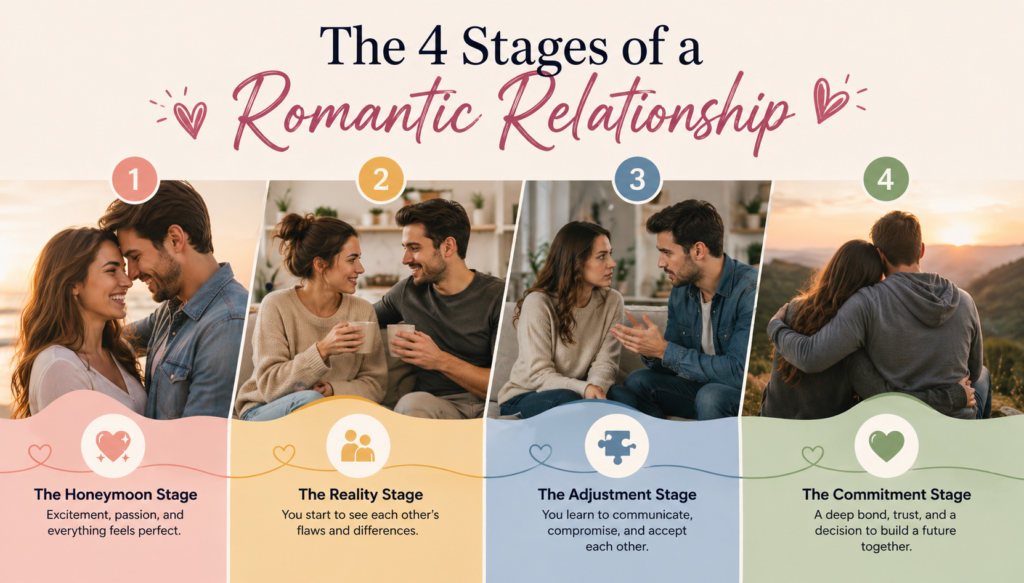
Every relationship begins with that unmistakable feeling: a racing heart, the desire to be together all the time, the certainty that this person is different from everyone else. But what happens after the excitement of the first few months starts to settle? Why do some couples move through turbulence and build something solid, while others don’t survive the first crisis?
Relationship psychology shows us that love is not a fixed state — it evolves. And understanding the stages that every relationship naturally goes through can completely change how you interpret what you’re experiencing.
1. The Euphoria Stage — “Everything is perfect”
At the beginning, the brain literally enters an altered state. Neuroscience studies show that falling in love activates the same reward circuits as substances like cocaine — with a surge of dopamine, serotonin, and norepinephrine that creates that constant sense of euphoria. You think about the person all the time, their flaws seem invisible, and life feels more vibrant.
This stage is beautiful and necessary — it creates the initial bond that will sustain the couple through more challenging phases. But it also distorts reality. You’re not seeing the person as they truly are; you’re seeing an idealized version, filtered by the chemistry of infatuation.
Its duration varies, but most experts suggest this intense phase lasts between six months and two years. When it begins to fade, many people interpret this change as a sign that love is over — when in fact, it’s just the beginning of the next stage.
2. The Conflict Stage — “Is this really what I wanted?”
As the fog of euphoria begins to lift, reality sets in. Habits that once seemed charming now become irritating. Differences in values, lifestyle, and expectations become clearer. The first serious conflicts arise — and with them, the question: “Did we rush into this? Is this person really compatible with me?”
This is the most critical stage of a relationship, and also the most misunderstood. Many couples break up here, believing that conflict is a sign of incompatibility. But psychology suggests the opposite: conflict is inevitable in any intimate relationship and, when navigated with maturity, is exactly what deepens the connection.
What separates couples who get through this stage from those who don’t is not the absence of conflict — it’s how they deal with it. Honest communication, willingness to listen, and the ability to repair moments of rupture are skills developed right here, in this uncomfortable phase.
3. The Stability Stage — “I choose you, every day”
If a couple moves through the conflict stage without falling apart, they arrive at a very different place from the initial euphoria — but one that is equally valuable. Stability doesn’t have the intense sparkle of the beginning, and that’s exactly why it’s often underestimated.
In this stage, love stops being something that simply happens and becomes an active choice. You know the other person’s flaws and choose to stay. You know they will disappoint you at some point — and you trust that you’ll get through it together. The sense of security built here allows both individuals to grow without threatening the bond.
This is also where many couples confuse stability with stagnation. Routine does exist — but it doesn’t have to mean boredom. What makes the difference is how intentionally both partners invest in the connection: meaningful conversations, moments of lightness, and genuine curiosity about each other’s inner world.
4. The Deep Attachment Stage — “We are a team”
The final stage isn’t guaranteed — it’s earned. Couples who reach this point have built something that goes far beyond initial attraction: a true partnership, a shared history, a language of their own.
Deep attachment is marked by an intimacy that only develops over time and through overcoming crises. There is a sense of “we” that doesn’t erase individuality but integrates it. The other person is no longer someone you’re discovering — they are someone you know deeply, and still continue to choose.
Research on long-term relationships shows that couples in this stage are not necessarily those who never argue or who have everything in common. They are the ones who have developed the ability to repair after conflicts, adapt to life’s changes, and keep investing in the relationship even when it doesn’t seem to “need” attention.
What can you do with this map?
Knowing that relationships go through stages doesn’t solve problems — but it completely changes the perspective from which you face them. When you understand that the discomfort of the conflict stage is a natural part of the process, it becomes easier not to run from it. When you recognize that stability is not the end of love but a more mature form of it, you stop chasing the past and start building the present.
No healthy relationship is built on autopilot. It requires presence, communication, and the willingness to grow together — even when it’s difficult, especially when it’s difficult. And if you feel stuck in one of these stages without being able to move forward, talking to a psychologist can help you understand what’s holding that movement back and what can be built from there.
