
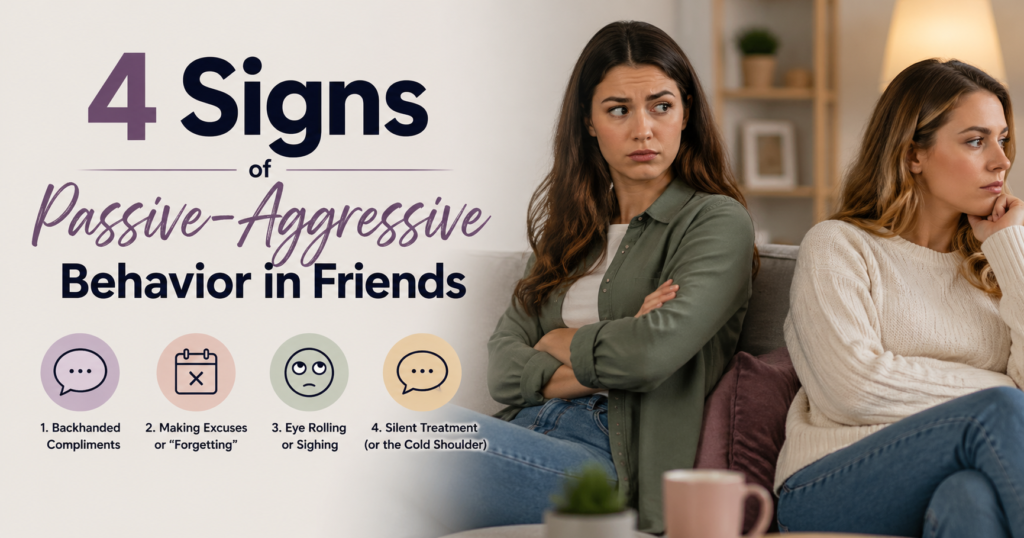
4 Signs of Passive-Aggressive Behavior in Friends
“You did really well for someone who doesn’t practice that much.” The sentence sounds harmless. But something about it feels off — and you can’t quite explain why.
Friendships are one of the most important pillars of emotional well-being. However, some relationships carry a subtle and unsettling dynamic: passive-aggressive behavior. Unlike overt aggression — which is easy to identify and label — passive aggression disguises itself as humor, concern, forgetfulness, or just a “personality trait.”
The result? You often leave an interaction with this friend feeling bad, confused, or diminished, without being able to pinpoint exactly what happened. That confusion itself is one of the hallmark signs of this pattern. Psychology defines passive-aggressive behavior as a way of expressing negative feelings — such as anger, resentment, or frustration — indirectly rather than openly. The person says one thing but acts another way. They agree verbally but sabotage in practice. They smile while delivering a veiled criticism.
1. Compliments That Aren’t Really Compliments
So-called backhanded compliments are a favorite tool of those who behave in a passive-aggressive way. On the surface, they seem kind. Underneath, they are disguised criticisms — and therefore nearly impossible to confront directly.
“Wow, you look great! I didn’t know that style suited you so well.” Or: “I loved your presentation. It’s amazing how well you did considering you didn’t have much time to prepare.”
The ambiguity is intentional. If you react, your friend can pull back and say, “It was a compliment!” — making you seem overly sensitive or dramatic. This confusion isn’t accidental: experts point out that these “non-compliments” are often rooted in envy or in the desire to bring someone down without appearing like the villain.
2. The Silent Treatment and the “I’m Fine”
Imagine you and a friend had a disagreement. You ask if everything is okay, and they say, “I’m totally fine” — but their tone is cold, their replies are short, and they stop responding to your messages. That’s the silent treatment in action.
People with passive-aggressive tendencies often deny being upset to avoid direct confrontation, but they express those feelings through distance, loaded looks, or minimal responses. The anger is there; it just isn’t allowed to show openly.
The silent treatment puts you in an impossible position: you sense that something is wrong, but you have nothing concrete to address. This generates anxiety, self-doubt, and often the feeling that you’re “overreacting” for noticing something the other person denies.
3. Sabotage Disguised as Carelessness
This sign is harder to spot precisely because there’s always a plausible excuse. A passive-aggressive friend rarely sabotages openly — they use forgetfulness, lateness, or strategic incompetence as a shield.
They’re always late when meeting you but punctual with others. They promised to help you with something important and “forgot” — right when you needed them most. They keep inviting you, knowing you’re trying to save money, to expensive places over and over again.
When confronted, they tend to defend themselves with “Sorry, it wasn’t intentional” — making it almost impossible to hold them accountable. The purpose of this behavior is to control and deflect responsibility for their anger, causing frustration in others without ever appearing to be the aggressor.
4. Sarcasm and Humor at Your Expense
There’s an important difference between shared humor among friends and sarcasm used as a weapon. In passive-aggressive behavior, jokes and irony are often used to express criticism or hostility — with the easy escape of “I was just kidding.”
“You’ve always been kind of dramatic, right? Haha, just kidding!” Or: “Wow, what a surprise to see you being on time.”
This creates a trap: if you react, you seem like you lack a sense of humor. If you don’t, the negative message is delivered successfully — at no cost to the person who said it. Repeated sarcastic comments at your expense are not a sign of healthy friendship — they’re a form of hidden hostility.
What Can You Do When You Notice These Signs?
Recognizing the behavior is the first step. The disorientation it causes decreases significantly once you can name what’s happening. Instead of saying “you’re being passive-aggressive,” try phrases like “I feel confused when…” or “I noticed a difference between what was said and what happened” — this reduces defensiveness and opens the door to a real conversation.
It’s also important to remember that it’s not your responsibility to fix a friend’s passive-aggressive behavior. You can offer clarity and direct communication, but change depends on them.
And if a relationship is causing chronic confusion or making you doubt your own perception, talking to a psychologist can help clarify the dynamic and strengthen your internal resources.
Healthy friendships are built on honest communication and the ability to handle conflict directly. You deserve relationships where you can trust what is said — and where you don’t leave every interaction questioning your own perception of reality.
