
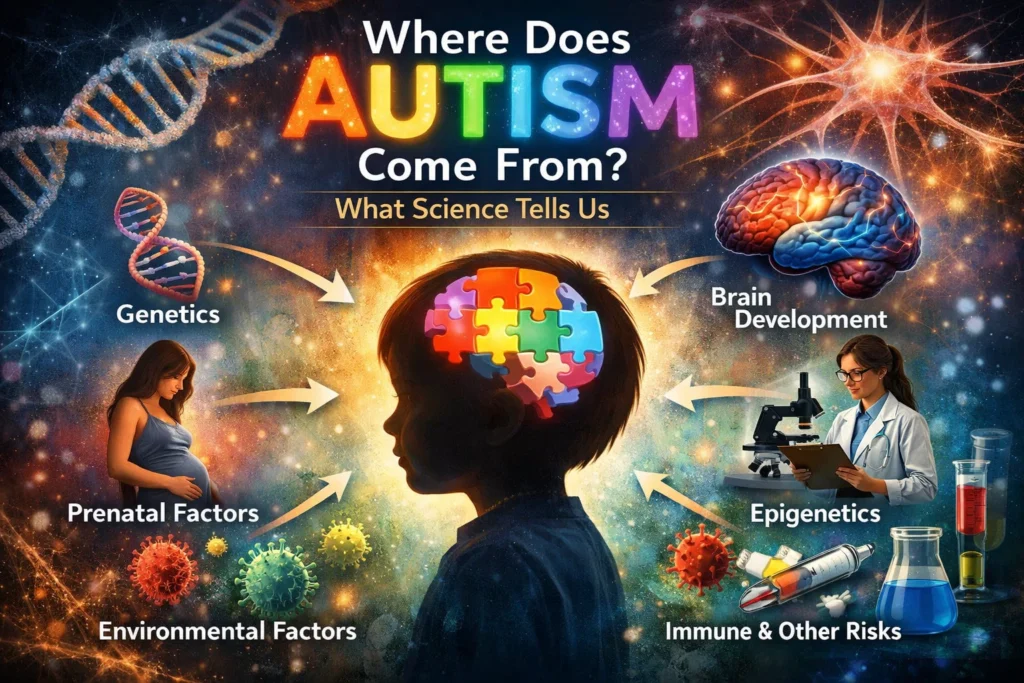
Where Does Autism Come From? What Science Tells Us
Autism Spectrum Disorder (ASD) is one of the most discussed — and most misunderstood — neurological conditions of our time. With diagnoses rising steadily over the past few decades, a natural question emerges: where does autism actually come from?
The short answer is: it’s complicated. But science has made remarkable progress, and what we know today is far more nuanced than the myths that once dominated the conversation.
It Starts in the Genes
The most well-established finding in autism research is that genetics plays a major role. Studies on twins have consistently shown that if one identical twin has autism, the other has a significantly higher chance of being on the spectrum too — far higher than with fraternal twins.
But autism isn’t caused by a single “autism gene.” Instead, researchers have identified hundreds of genetic variants that can contribute to the condition. Some are inherited from parents; others arise as spontaneous mutations. This genetic complexity is one reason why autism looks so different from person to person.
The Brain Develops Differently
Autism is fundamentally a condition of brain development. Research shows that in autistic individuals, certain areas of the brain form different connections during early fetal development — even before birth. The way neurons migrate, organize, and communicate appears to follow a distinct pattern.
This doesn’t mean the autistic brain is “broken.” It’s wired differently, which can bring both challenges and unique strengths.
Environmental Factors: A Piece of the Puzzle
While genes are central, they don’t tell the whole story. Scientists believe that certain environmental factors, particularly during pregnancy, may interact with genetic predispositions to influence development. Some factors currently under investigation include:
- Advanced parental age at the time of conception
- Prenatal exposure to certain medications, infections, or pollutants
- Complications during pregnancy or birth, such as extreme prematurity
- Immune system dysregulation in the mother during pregnancy
It’s important to stress that none of these factors cause autism on their own. They are potential contributors in a much larger, more complex picture.
What Does NOT Cause Autism
Let’s address the elephant in the room: vaccines do not cause autism. This claim originated from a fraudulent 1998 study that has since been thoroughly debunked and retracted. Decades of research involving millions of children across dozens of countries have found no link whatsoever between vaccines and autism.
Similarly, bad parenting, too much screen time, or diet are not causes of autism — though these myths have unfortunately persisted in popular culture and caused real harm to families.
Why Are More People Being Diagnosed Today?
Many people wonder if autism is actually becoming more common, or if we’re just getting better at recognizing it. The answer is likely both.
Diagnostic criteria have expanded significantly. Conditions that were once overlooked — especially in girls, adults, and high-functioning individuals — are now being properly identified. Greater awareness among parents, teachers, and clinicians also means more people are being referred for evaluation.
That said, researchers continue to investigate whether true biological increases are also at play.
The Bottom Line
Autism arises from a complex interplay of genetic and environmental factors that shape brain development, mostly before a child is even born. It is not a disease to be cured, nor a mystery to be feared — it is a different way of experiencing and interacting with the world.
As science continues to evolve, so does our understanding. And with better understanding comes better support, more inclusion, and a world that makes room for all kinds of minds.
Did you find this article helpful? Share it with someone who wants to understand autism better.
