
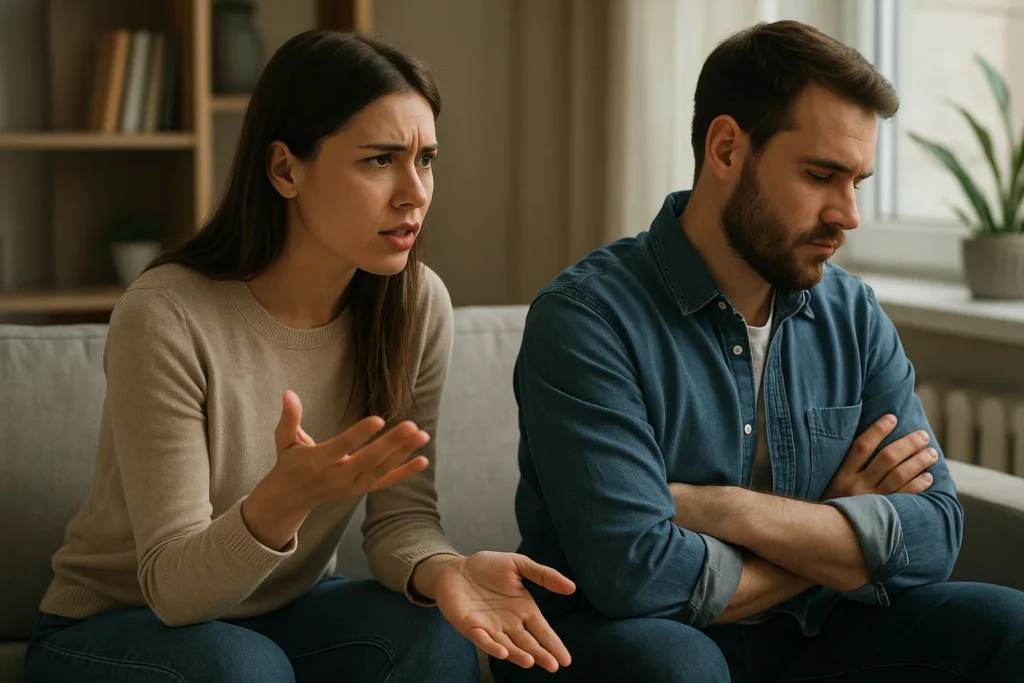
How to Deal When Your Partner Doesn’t Want to Talk About Problems
Few things are as distressing as realizing that your partner shuts down precisely when you most need to talk. It’s frustrating, anxiety-provoking, and often triggers painful doubts:
“Do they even care?”
“Are they hiding something from me?”
“Why do they always avoid the subject when I try to talk?”
Before assuming a lack of interest, it’s important to remember this: not everyone learned how to handle difficult conversations. Many people freeze, avoid, postpone, or become defensive — not because they don’t care, but because they lack emotional skills.
In this article, you’ll understand why some partners avoid talking about problems, how this affects the relationship, and what practical strategies can help you build healthier communication. The approach here is supportive, clear, and grounded in psychology.
Why Do Some Partners Avoid Talking About Problems?
There are several psychological and emotional reasons why someone avoids difficult conversations. Understanding them is the first step toward reducing conflict rather than escalating it.
1. Fear of Conflict
Some people associate conversations about problems with arguments.
This often comes from family history, past relationships, or attachment style.
Example:
If someone grew up in a home where every serious conversation turned into a fight, it’s natural for them to avoid those discussions as adults.
2. Difficulty Expressing Emotions
Not everyone knows how to verbalize feelings like frustration, insecurity, or sadness.
They may want to resolve things but don’t know where to start.
3. Physiological Stress Response
For some people, talking about problems activates the fight-or-flight response.
They feel anxious, tense, overwhelmed — and leaving the situation feels safer.
4. Avoidance as a Defense Mechanism
Some avoid conversations to escape guilt.
Others believe that “letting time pass” will fix everything.
5. Lack of Communication Skills
No one is born knowing how to communicate well. Many people were never taught how to:
listen without reacting defensively,
validate the other person,
express emotions clearly,
stay calm during uncomfortable topics.
6. Fear of Disappointing the Partner
Some people avoid conversations because they’re afraid of hurting or disappointing the person they love.
When Does This Become a Serious Relationship Problem?
Avoiding conversations occasionally is normal.
But when it becomes a pattern, the consequences can be serious:
unresolved resentment,
emotional loneliness,
emotional distance,
recurring conflicts,
misunderstandings,
relationship burnout.
Communication is the circulatory system of a relationship.
Without it, nothing flows.
Everyday Examples
Example 1 — “We’ll talk about it later” that never happens
Marina tries to discuss finances. Her partner replies, “Not now, we’ll talk later.”
That “later” never comes. Marina begins to feel emotionally alone.
Example 2 — Emotional shutdown and silence
During a mild disagreement, Pedro goes completely silent.
He learned early in life that speaking only makes things worse.
Example 3 — Humor as avoidance
Carla tries to talk about jealousy. Her boyfriend responds with jokes:
“Relax, you’re overthinking.”
Humor becomes a way to escape discomfort.
Example 4 — Walking away
For some people, the discomfort is so intense that leaving the room feels like the only option — which often creates feelings of abandonment in the partner.
How to Handle This Without Pressuring or Escalating
1. Choose the Right Moment
Important conversations need the right emotional timing. Avoid starting them:
when someone is exhausted,
right after work,
in the middle of a conflict,
when time is limited.
A better approach:
“Can we talk about something important tonight? It won’t take long.”
Predictability reduces anxiety.
2. Use Emotional Language, Not Accusations
Avoid statements like:
“You never want to talk.”
“You always avoid conversations.”
“You don’t care about me.”
Instead, try:
“I feel lonely when we don’t talk.”
“I get anxious when things stay unresolved.”
“I want us to communicate better, not fight.”
This completely changes the emotional tone.
3. Keep Conversations Short
People who avoid conversations often feel overwhelmed quickly.
Instead of long talks, use small emotional doses.
Example:
“Can we talk for five minutes? I’ll be brief.”
This significantly increases openness.
4. Validate Your Partner’s Feelings
Say things like:
“I know these conversations make you uncomfortable.”
“I understand this isn’t easy for you.”
“I don’t want to pressure you.”
Feeling understood makes openness safer.
5. Clarify Your Intention
Many people avoid talking because they expect conflict.
Reassure them:
“My goal isn’t to argue — it’s to understand each other and feel closer.”
6. Ask What Would Make It Easier
Offer choices:
timing,
location,
topic,
short conversations,
breaks.
This restores a sense of control.
7. Respect Emotional Pace
Everyone processes emotions differently. Some need minutes, others hours, sometimes a day.
This isn’t lack of love — it’s emotional processing.
Allow time, but don’t allow emotional disappearance.
8. Set a Clear Time to Revisit the Conversation
Avoidance becomes harmful when it turns into emotional vanishing.
Say:
“Okay, I’ll give you some time. Can we talk tomorrow at 7 PM?”
This prevents emotional uncertainty.
9. Acknowledge Effort
Every attempt matters.
Say:
“Thank you for talking with me. I know this isn’t easy for you.”
Positive reinforcement encourages future openness.
What to Avoid at All Costs
Pressuring during emotional shutdown
Forcing long conversations
Using threats or ultimatums
Interpreting avoidance as lack of love
Most of the time, it’s not lack of love — it’s lack of emotional skills.
When This Signals Something More Serious
If your partner avoids all conversations for weeks or months — even essential ones — it’s time to look deeper.
This may involve:
depression,
high anxiety,
past trauma,
low self-esteem,
fear of conflict,
emotional withdrawal,
serious communication difficulties,
toxic relational patterns.
Professional help becomes essential.
The Role of Couples Therapy
Therapy helps couples:
unblock communication,
identify avoidance patterns,
learn nonviolent communication,
reduce emotional triggers,
create healthy agreements,
strengthen emotional connection.
Couples who learn to communicate respectfully rarely reach breaking points.
Final Thoughts
Dealing with a partner who avoids conversations is genuinely difficult.
But with the right strategies, communication can become safer, lighter, and more constructive.
Remember:
Avoidance doesn’t mean lack of love.
Communication is a learned skill.
Everyone has their emotional rhythm.
The goal isn’t winning — it’s understanding.
When both partners are willing to grow, relationships deepen, mature, and become more resilient.
