
⚓ Introduction: When Faith is the Rudder and Science is the Engine
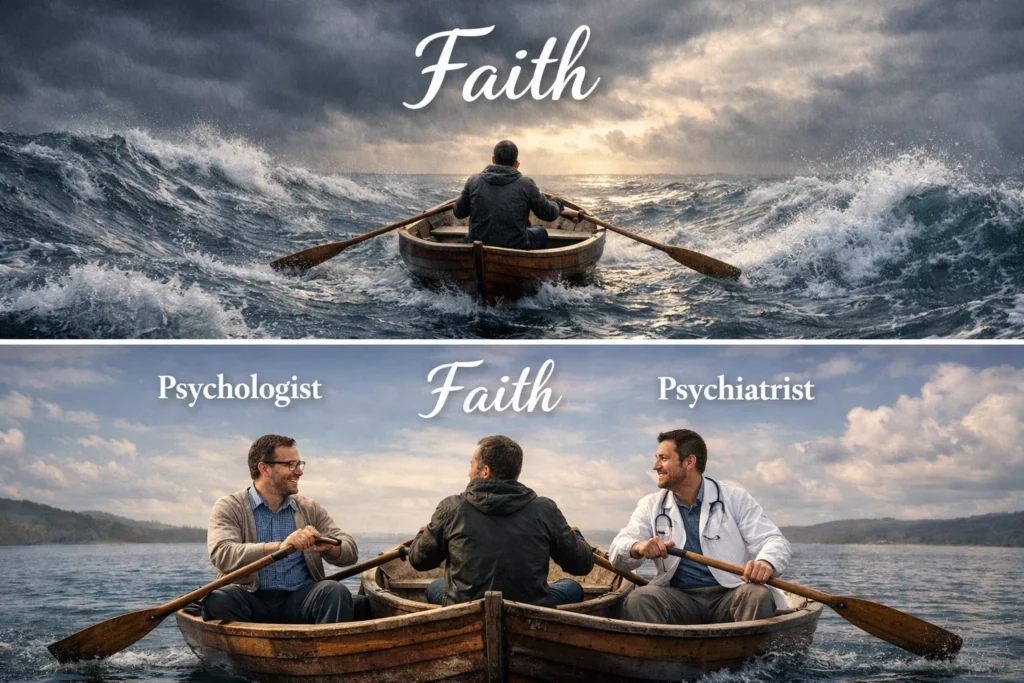
The image of a boat adrift, alone in a stormy sea, conveys the feeling of someone facing a profound mental health crisis. Faith is undoubtedly a powerful element. It is the rudder that guides us, offers us meaning, hope, and the strength not to give up.
But when the storms of the soul are persistent—manifesting as depression, anxiety, or burnout—willpower and belief alone may not be enough. At those times, we need more solid resources to stabilize the ship and get back on course.
Psychology and psychiatry emerge not as substitutes for faith, but as precision instruments: the oars and the engine that guarantee the crossing. The holistic care of mind and spirit requires that we abandon the taboo of “either/or” and embrace the wisdom of “and” .
In this article, we will explore the specific function of each of these “oars” and how their union offers complete support— spiritual, emotional, and biological —for healing.
Psychology: Understanding, Welcoming, and Strengthening the Navigator
The psychologist works on the emotional and behavioral dimensions . They are the guide who helps the individual to map their inner waters, identifying the rocks (traumas, unresolved conflicts) and the headwinds (destructive thought patterns and limiting beliefs).
Crucial Functions of Therapy:
- Promoting Self-Awareness: Therapy offers a safe space for individuals to name what they feel, understand the origin of their pain, and recognize their emotional triggers.
- Development of Tools: The psychologist teaches coping techniques and strategies (such as cognitive restructuring in CBT or emotion management) that transform suffering into learning and action.
- Reframing Pain: It helps the individual not to be defined by their crisis, but to integrate it as part of their story, finding a new purpose and meaning to move forward.
While faith offers a broader perspective on the purpose of life, psychology grounds that vision, making it practical and applicable in daily life, transforming mental patterns that sabotage health.
Psychiatry: Rebalancing the Machine and Ensuring Biological Functioning
A psychiatrist, on the other hand , is a medical specialist in the biological dimension of mental health. They work directly on the “engine” of the boat: the brain .
More serious mental disorders, such as moderate to severe depression, bipolar disorder, schizophrenia, or panic disorder, often involve imbalances in neurotransmitters (such as serotonin, dopamine, and norepinephrine). In these cases, faith and therapy alone may not be enough to reverse the clinical picture.
The Importance of Medical Treatment:
- Direct Chemical Action: The psychiatrist prescribes medications (antidepressants, anxiolytics, mood stabilizers) that work by rebalancing brain chemistry.
- Improving the Biological Basis: The medication does not cure the soul, but it removes the biological barrier that hinders the effectiveness of faith and therapy. By alleviating severe symptoms (chronic insomnia, debilitating anhedonia), the patient regains the energy and mental clarity necessary to actively participate in therapy and exercise their faith.
- Differential Diagnosis: A psychiatrist is essential to rule out or diagnose other clinical conditions that may mimic psychiatric symptoms (e.g., thyroid problems).
Seeking a psychiatrist is not a sign of a character flaw or lack of faith, but rather the scientific recognition that suffering often has a physical basis that needs to be treated with appropriate science.
Faith: The Axis, the Meaning, and the Fuel of Hope
Faith , understood here in its broadest sense (not necessarily linked to a specific religion), operates in the spiritual and existential dimension . It is the central axis that connects the two scientific approaches.
Faith as Support in the Storm:
- Resilient Strength: Belief in a greater purpose, in a transcendent power, or simply in one’s own capacity for overcoming challenges, provides the resilience to endure the most difficult moments.
- Community and Belonging: Faith often manifests itself in communities (religious, spiritual groups) that provide a crucial social support network against isolation.
- Relief from Existential Anguish: It offers answers (or the comfort of acceptance) to life’s big questions, lessening anguish and existential emptiness.
Without faith, even if the body is balanced by psychiatry and the mind is understood by psychology, the intrinsic motivation to move forward may be lacking. Faith, therefore, is the fuel of hope that drives the healing process.
Powerful Synergy: When the Three Oars Work Together
True healing happens when these three pillars work in synergy .
| Dimension | Resource | Function in the Healing Process |
| Biological (Body) | Psychiatry | It stabilizes the body; it rebalances brain chemistry. |
| Emotional (Mind) | Psychology | It helps to understand and transform patterns of thought and behavior. |
| Spiritual (Soul) | Faith | It provides purpose, resilience, hope, and a sense of community. |
This holistic approach ensures that the individual is not merely relieving a symptom, but rebuilding their life in a solid and balanced way . Medication provides the foundation; therapy teaches how to build; and faith provides the reason for the construction.
Breaking the Stigma: Caring for the Mind is a Spiritual Act
It is crucial to dispel the outdated belief that seeking medical or psychological help is a sign of “lack of faith.” This view, besides being obsolete, is dangerous because it delays treatment.
Caring for the mind and body, which are the dwelling place of the spirit, is an act of responsibility and spiritual maturity . God or the Universal Force manifests its care and wisdom not only in miracles, but also in human knowledge (Science). Psychologists and psychiatrists are instruments of this knowledge.
Seek help without guilt. Strengthening faith with awareness, treating the body with science, and caring for the mind with the support of therapy is the most complete and courageous way to weather any storm.
🌊 Final Thoughts: Navigating with Wisdom
No ship crosses a stormy ocean relying solely on luck or a single instrument.
Human beings need support in all aspects of their lives. Faith is essential. Psychological and psychiatric treatment are vital. Together, they form the most complete and effective care strategy for coping with adversity.
If you are in the midst of a storm, remember: there is no need to row alone. Reach out to faith, to a psychologist, and to a psychiatrist. Taking care of your mind, body, and spirit is rowing with balance, towards inner peace and holistic mental health.
