
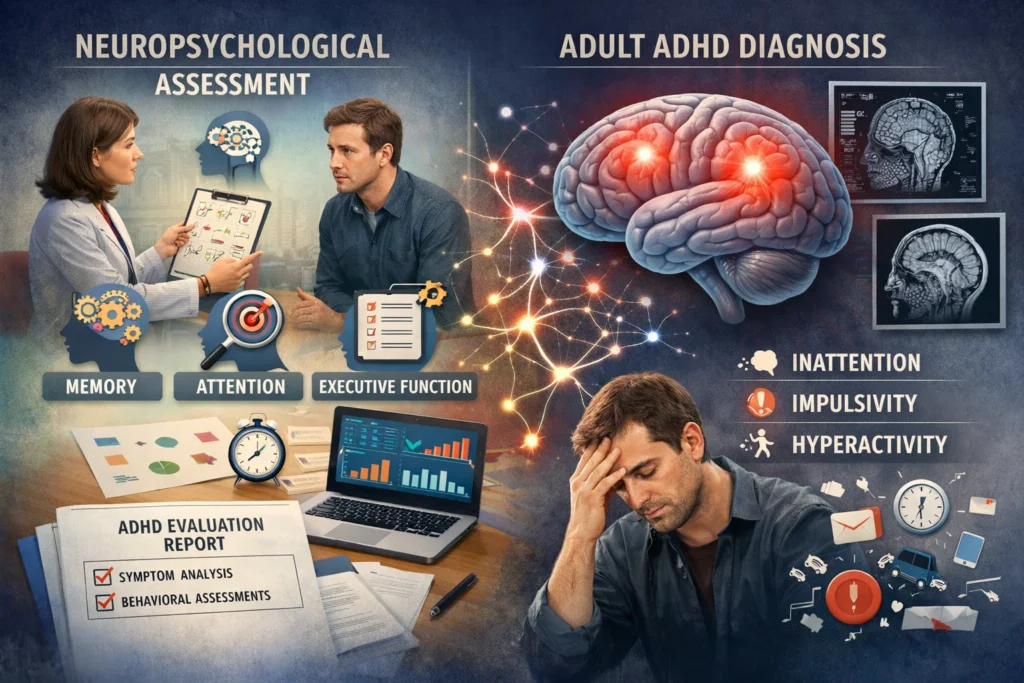
The role of neuropsychology in the diagnosis of ADHD in adults.
For a long time, Attention Deficit Hyperactivity Disorder (ADHD) was believed to be a problem exclusive to childhood. However, today it is known that it can persist into adulthood , affecting relationships, professional performance, and even self-esteem.
In many cases, adults experience difficulties concentrating, impulsivity, forgetfulness, and disorganization without realizing that these symptoms may be related to ADHD. It is in this context that neuropsychology becomes fundamental.
The role of neuropsychology in diagnosing ADHD in adults is to understand how the brain processes information, identify patterns of cognitive functioning, and differentiate the disorder from other conditions that cause similar symptoms, such as anxiety or depression.
What is neuropsychology and how does it work?
Neuropsychology is a branch of psychology that studies the relationship between brain function and human behavior . Through standardized tests, interviews, and observations, neuropsychologists assess functions such as:
Attention and memory;
Language;
Processing speed;
Planning and organization;
Inhibitory control;
Logical reasoning and decision-making.
These cognitive skills are essential for daily life, and in the case of ADHD, some of them may be compromised. The key difference with neuropsychology is that it provides objective and measurable data , assisting psychologists and psychiatrists in confirming the diagnosis.
Why diagnosing ADHD in adults is challenging
Diagnosing ADHD in adults is often more complex than in childhood. This is because:
Symptoms change over time. The adult may no longer be physically hyperactive, but may exhibit constant mental agitation.
There is overlap with other disorders. Anxiety, depression, and even chronic stress can generate similar symptoms.
Many develop compensatory strategies. Some adults learn to mask their difficulties, which makes it harder to perceive the problem.
Given these nuances, neuropsychological assessment is essential to understand current cognitive functioning and the specific difficulties of each individual.
How is neuropsychological assessment performed?
The process generally occurs in several stages:
Initial interview: the neuropsychologist talks to the patient to understand their life history, routine, symptoms, and family history.
Test application: standardized instruments are used to assess attention, memory, executive functions, language, and other cognitive aspects.
Analysis of results: the data obtained are compared with normative parameters, allowing the identification of possible deficits or typical patterns of ADHD.
Feedback and report: the professional explains the results clearly and, if necessary, refers the patient for psychological or psychiatric follow-up.
This detailed analysis allows us to differentiate ADHD from other conditions and guide a more effective and personalized treatment.
Difference between psychological and neuropsychological assessment
Although both involve assessment tools and techniques, there are important differences:
Psychological assessment focuses on emotional, behavioral, and personality aspects.
Neuropsychological assessment investigates cognitive functioning and its relationship to the brain.
In the case of ADHD diagnosis in adults , it is common for the two types of assessment to complement each other, offering a complete overview of the patient.
The role of the psychologist and psychiatrist in the process
The collaborative work of a neuropsychologist, clinical psychologist, and psychiatrist is essential for an accurate diagnosis.
The neuropsychologist provides objective data about cognitive functioning.
The psychiatrist assesses the need for medication, especially in cases of significant impairment.
The clinical psychologist works on behavioral and emotional strategies, helping the patient to cope with the challenges of the disorder.
This multidisciplinary approach ensures a more complete and effective treatment.
What the assessment can reveal
In addition to confirming an ADHD diagnosis, neuropsychological assessment can reveal other important aspects, such as:
Cognitive strengths that the patient can use to their advantage;
Areas that require rehabilitation or cognitive training;
Comorbidities such as anxiety, dyslexia, or depression;
Emotional and behavioral impact of symptoms on daily life.
This information helps personalize treatment and guides the patient in developing practical strategies to improve their quality of life.
The importance of a correct diagnosis.
Many adults spend years believing they are “disorganized,” “distracted,” or “lazy,” when in reality they live with ADHD without knowing it. Receiving the correct diagnosis is not a label, but a key to self-awareness and care .
Knowing what is really happening allows one to seek psychological support, adopt coping strategies and, when necessary, start medication treatment with a psychiatrist.
Furthermore, the diagnosis helps to reduce guilt and judgment, bringing understanding and self-compassion.
Final considerations
The role of neuropsychology in the diagnosis of ADHD in adults is to shed light on how the mind works, differentiating symptoms, identifying potential, and offering pathways for treatment.
When combined with psychotherapy and, if necessary, psychiatric follow-up, it becomes a powerful ally for those seeking balance, productivity, and emotional well-being.
Seeking help is not a sign of weakness — it’s the first step towards self-knowledge and the freedom to be who you are, with clarity and purpose.
