
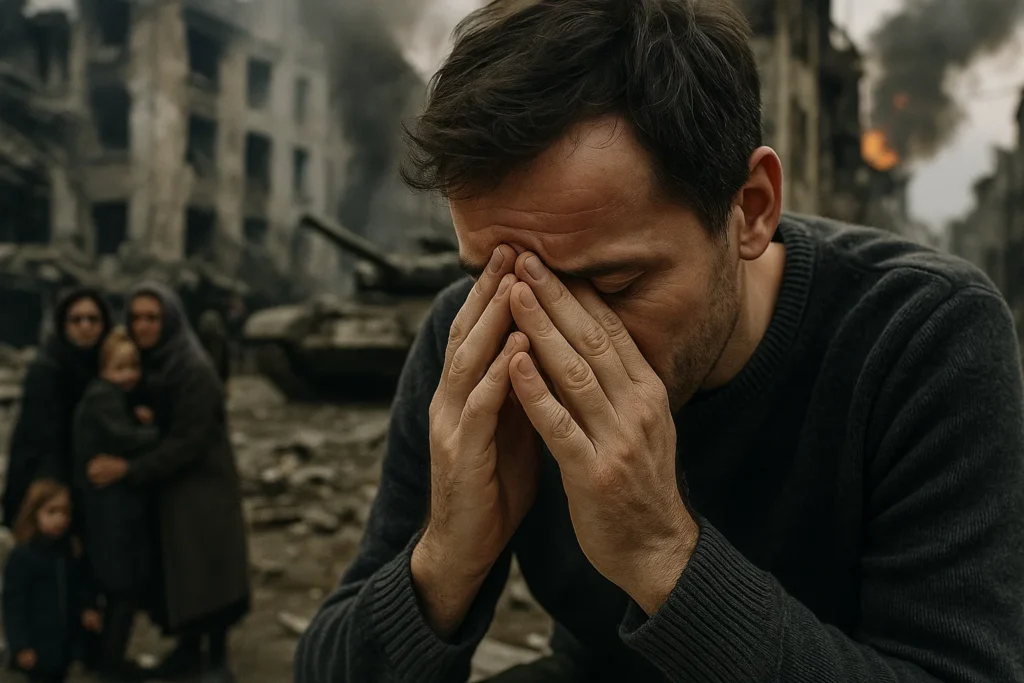
The psychological impact of war: how to cope with the pain of witnessing so much suffering.
Wars have always shaken humanity, but in recent years, the psychological impact of these conflicts has become even more profound. With the advancement of technology and social media, we are exposed daily to shocking videos, images, and accounts—often in real time.
Seeing soldiers being attacked, cities destroyed, and families fleeing evokes a mixture of sadness, helplessness, and fear . Even from a distance, this content triggers intense emotional responses within us. But why does this happen? And how can we protect our minds in the face of so much pain?
1. War and the human brain: why are we so affected?
Humans were not created to deal with constant violence. Our brains react to images of war as if the danger were real and immediate , activating the alert system (amygdala) and releasing stress hormones such as cortisol and adrenaline.
Even when not on the battlefield, the body enters a state of hypervigilance —rapid heartbeat, anxiety, and difficulty sleeping. This reaction is natural: the brain doesn’t differentiate between the danger on the screen and the danger that would be directly in front of us.
Furthermore, empathy plays an important role. When we see human suffering, especially that of ordinary people, the elderly, or children, we activate the same brain circuits involved in physical pain. That’s why we feel a real weight, a sadness that seems to come “from the chest.”
2. The emotional bombardment of social media
Today, wars are not only fought in the physical realm, but also on screens.
Digital platforms broadcast scenes of destruction unfiltered, repeatedly. This excess of stimuli can generate emotional fatigue and even desensitization , when the brain tries to protect itself by ceasing to react.
But the price of this is high: we can feel numb, apathetic, or hopeless . Many report thoughts such as:
“The world is lost.”
“Nothing makes sense.”
“I can’t stand seeing so much violence anymore.”
These reactions are signs of emotional overload and need to be recognized. Witnessing human suffering every day without time to process it is something that affects even experienced professionals—imagine how it affects someone who is simply seeking information.
3. When empathy hurts: vicarious trauma
There’s a term in psychology called vicarious trauma . It describes the emotional suffering we feel when witnessing the pain of others , even without directly experiencing that situation.
In war contexts, vicarious trauma is common among journalists, mental health professionals, and even viewers who frequently follow the news. The brain absorbs the emotions seen—fear, despair, grief—and can develop symptoms similar to post-traumatic stress, such as:
Nightmares or insomnia after watching war videos;
Anxiety and tension when viewing scenes of violence;
Avoidance of news or widespread fear of the future;
A constant feeling of insecurity.
Recognizing these signs is the first step in taking care of your mental health.
4. What can we do to preserve emotional balance?
Although we cannot control what happens in the world, we can choose how to care for our minds in the face of these events. Some simple actions can help reduce the psychological impact of war:
🧩 1. Limit your exposure
Avoid watching violent videos or reading excessive amounts of news. Set specific times to get informed and then switch off. Mental rest is essential.
🌿 2. Cultivate pauses and calming rituals.
After watching difficult news, do something that brings peace: listen to music, take a walk, pray, meditate, or talk to someone you trust. Your body needs a signal that “the danger has passed.”
💬 3. Talk about how you feel.
Talking about sadness and helplessness helps to process emotions. Keeping everything to yourself can increase suffering.
❤️ 4. Practice active compassion
Transforming pain into acts of solidarity is therapeutic. Supporting humanitarian campaigns, praying for victims, or promoting peace are ways to give meaning to what we feel.
🧠 5. Seek psychological support.
If the emotional burden is intense, therapy can help to reframe the fear and pain . The psychologist offers a safe space to understand what these images evoke in you.
5. War as a mirror of human frailty.
Watching war is confronting our own vulnerability. It’s realizing that, everywhere, there are lives that feel, suffer, and love —and that violence is never a lasting solution.
By acknowledging the psychological impact of war, we are not being weak—we are being human .
Empathy is a sign of emotional health, but it needs to be balanced with self-care. It is possible to care without destroying oneself.
Final considerations
The psychological impact of war goes far beyond the borders of the countries in conflict. It reaches those who see, those who feel, and those who care about the suffering of others.
Therefore, caring for one’s mind during times of war is not selfishness—it’s emotional preservation . In a world that shows so much pain, being able to feel and still choose good is an act of courage and humanity.
