
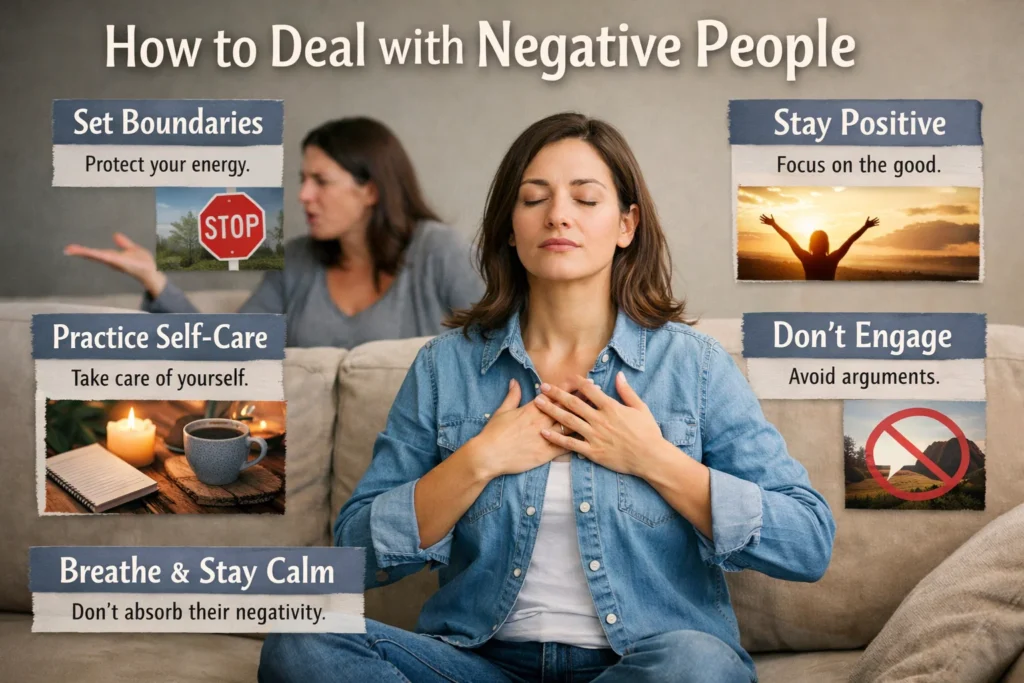
🧠 How to deal with negative people and protect your emotional health
We interact with many different types of people every day—at work, in our families, among friends, and even on social media. Some of them radiate lightness and inspiration, while others seem to carry a gray cloud over them. Dealing with negative people can be a real challenge, especially when their energy and behavior directly affect our emotional health .
In this article, you will understand how to identify this type of relationship, what the psychological impacts are, and, most importantly, how to protect yourself emotionally, maintaining balance and mental well-being.
1. What characterizes a negative person?
A negative person is someone who constantly sees the bad side of situations, criticizes, complains, or demotivates others. This isn’t always intentional—often it stems from deeply ingrained traumas, frustrations, or limiting beliefs.
Among the main behaviors are:
Talking more about problems than solutions.
Complaining about everything and everyone.
Having difficulty recognizing the positive aspects of life.
To devalue the achievements of others.
Such relationships, if prolonged, can lead to emotional strain and even symptoms of stress and anxiety .
2. How negative people affect your emotional health
Frequent contact with negative people can be compared to “emotional contamination.” Daily exposure to this type of behavior tends to:
Reduce enthusiasm and personal motivation;
Increase stress levels;
To encourage pessimistic thoughts;
It can disrupt sleep and focus;
To affect self-esteem.
Over time, this impact can compromise psychological well-being and even lead to emotional exhaustion , a condition in which a person feels drained and discouraged, even without apparent reason.
3. Psychological strategies for dealing with negative people
Psychology offers several tools to strengthen your emotional health when facing difficult environments or people. Here are some of them:
3.1. Establish healthy boundaries.
Clearly define what you accept and what you don’t accept in a conversation or relationship. Saying “no” is an act of self-care, not selfishness.
3.2. Avoid engaging in unproductive discussions.
Negative people tend to insist on conflict. Avoid arguing back or trying to “prove” them wrong—this only fuels the toxic dynamic.
3.3. Take care of your emotional energy.
Set aside time for activities that recharge your energy, such as meditation, therapy, physical exercise, or contact with nature.
3.4. Develop empathy with balance.
Not everyone who is negative intends to harm others. Often, these people suffer internally. Empathy helps to understand without becoming too emotionally involved.
3.5. Reinforce positive thoughts
Replace negative automatic thoughts with more realistic and constructive phrases. This practice strengthens optimism and emotional resilience.
4. When it’s time to walk away
In some cases, even with empathy and patience, coexistence becomes unsustainable. When a relationship starts to generate constant suffering, destructive criticism, or emotional manipulation, it’s time to rethink the bonds.
Distancing yourself doesn’t mean giving up on the person, but prioritizing your mental health . Taking a step back can be a form of self-love and emotional preservation.
5. The role of therapy in this process
Therapy is a fundamental tool for those who live with negative people and feel emotionally affected. The psychologist helps the patient to:
Identify emotional triggers and behavioral patterns;
Learn strategies to protect yourself emotionally;
To strengthen self-esteem and self-confidence;
Develop assertive communication skills.
With psychological support, it is possible to restore inner balance and build healthier, more mature relationships.
Final considerations
Dealing with negative people requires patience, empathy, and self-awareness. However, it’s essential to remember that you are not responsible for the emotions or choices of others. The priority should always be protecting your emotional health , standing firm in your values and boundaries.
Psychology offers safe and effective ways to achieve this balance — and the first step is recognizing when a relationship is wearing you down more than strengthening you.
