
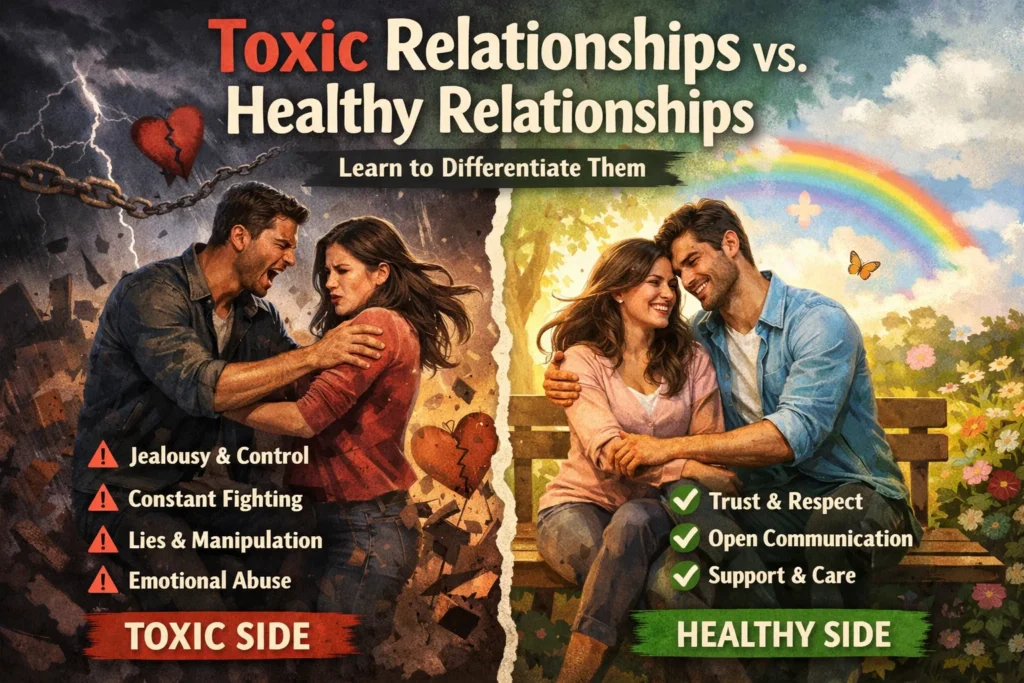
Toxic relationships vs. healthy relationships: learn to differentiate them.
It’s not always easy to tell when a relationship stops being healthy and starts becoming toxic.
Often, the bond begins with affection and sincere promises, but gradually, control, devaluation, and emotional games take the place of respect and security.
Understanding the differences between a toxic relationship and a healthy relationship is essential to protecting your mental health and developing more balanced bonds .
In this article, we will explore the warning signs, the psychological impacts, and how to seek help to transform or end a cycle of suffering.
What is a toxic relationship?
A toxic relationship is one characterized by emotional imbalance, lack of respect, and behaviors that undermine the well-being of the other person.
In such a relationship, one or both parties maintain attitudes that cause constant suffering, even if love or attachment exists.
Toxicity can manifest in various ways — subtle or explicit — and usually involves emotional manipulation, emotional dependency, and insecurity .
Key characteristics of a toxic relationship:
Constant criticism or veiled humiliation.
Excessive control over what the other person does, wears, or talks to.
Excessive jealousy and invasion of privacy.
Emotional blackmail (“If you loved me, you would do this for me”)
Punitive silence and deliberate distancing.
Lack of empathy and devaluation of feelings.
Cycles of intense fights followed by passionate reconciliations.
These dynamics create an emotional rollercoaster, in which the partner feels confused, insecure, and dependent on the other’s approval.
Clinical example: when love hurts
Mariana, 29, sought therapy because she was in a relationship where she constantly felt “guilty for everything.”
Her boyfriend alternated between being affectionate and attentive, and then suddenly becoming cold and critical.
She believed the problem was with her—until she understood, in therapy, that she was living in a cycle of emotional abuse .
With psychological support, Mariana learned to recognize the signs of manipulation, strengthen her self-esteem, and rebuild her emotional autonomy.
This process helped her end the relationship and begin a new phase of self-discovery and self-care.
What is a healthy relationship?
A healthy relationship is built on the foundations of mutual respect, empathy, trust, and freedom.
This doesn’t mean there won’t be conflicts—but differences are resolved through dialogue, not aggression or blackmail.
Key pillars of a healthy relationship:
Clear and empathetic communication
Mutual support in times of difficulty.
Respect for individuality
Freedom to express opinions and feelings.
Trust and emotional security
Affective responsibility
Balance between giving and receiving
A healthy relationship doesn’t drain your energy —it multiplies it.
You feel free to be yourself, without fear of being judged or rejected.
Differences between a toxic relationship and a healthy relationship.
| Aspect | Toxic Relationship | Healthy Relationship |
|---|---|---|
| Communication | Criticism, sarcasm, punitive silence | Open and respectful dialogue |
| Emotions | Anxiety, fear, guilt | Safety, joy, and peace of mind. |
| Limits | They are ignored or ridiculed. | They are respected and reinforced. |
| Individuality | Controlled and stifled | Encouraged and valued |
| Power | One dominates the other. | Both have voice and balance. |
| Affection | Conditional and manipulative | Free, affectionate and genuine |
Recognizing these differences is the first step in identifying dysfunctional emotional patterns and beginning the process of change.
Why is it so difficult to leave a toxic relationship?
Even when there is suffering, many people have difficulty breaking up.
This happens because the relationship often alternates between phases of affection and abuse — creating what is known as the cycle of emotional violence .
In these cases, the brain associates intermittent affection with unpredictable rewards, releasing dopamine (the neurotransmitter of pleasure).
This pattern generates emotional dependence , similar to that of an addiction.
Furthermore, factors such as low self-esteem, fear of loneliness, hope for change, and even religious beliefs can keep a person trapped in this cycle.
Psychological impacts of a toxic relationship
The emotional effects can be profound and lasting.
Among the most common are:
Generalized anxiety
Depression and hopelessness
A feeling of constant confusion or guilt.
Social isolation
Difficulty trusting again
Loss of identity and self-esteem
In some cases, emotional trauma or symptoms of post-traumatic stress disorder (PTSD) develop , especially when there is intense manipulation, gaslighting, or psychological violence.
Warning signs that the relationship is harming you.
You feel afraid to express your opinion.
He believes he needs to change in order to be loved.
He’s always apologizing for small things.
He realizes he is always emotionally exhausted.
His friends and family are showing concern.
Have you ever thought about ending things, but feel guilty or afraid of the other person’s reaction?
If you identified with more than one of these signs, it’s time to reflect on the emotional quality of the relationship and seek psychological support.
How to transform or leave a toxic relationship.
1. Acknowledge the problem
The first step is to admit that something is wrong.
Denying the suffering only prolongs the cycle of pain.
2. Boost your self-esteem.
Therapy can help you rebuild your self-confidence and understand that you don’t deserve to be mistreated .
Rediscovering hobbies, friendships, and personal goals is essential in this process.
3. Establish clear boundaries.
Learning to say “no” and maintaining firm emotional boundaries is an act of self-love.
If the other person doesn’t respect your limits, that’s already a warning sign.
4. Seek emotional support.
Talking to friends, family, or a therapist helps to see the situation more clearly.
Isolation is one of the main factors that keep a person trapped in a toxic relationship.
5. Plan your exit safely.
If there is control, threats, or violence, it is essential to seek specialized help .
In Brazil, the number 180 offers free and confidential assistance to women experiencing abuse.
When couples therapy can help (and when it shouldn’t be recommended)
Couple’s therapy can be helpful in cases of relationship conflicts, communication breakdowns, or crises in cohabitation.
However, it is not recommended when there is violence, blackmail, or psychological abuse , as these contexts require individual protection before any attempt at reconciliation.
In toxic situations, the therapeutic focus should be on rebuilding the self-esteem and sense of emotional autonomy of the suffering partner.
How to identify a healthy relationship after a toxic experience.
After leaving an abusive relationship, it’s natural to feel afraid to get involved again.
But, with time and psychological work, it’s possible to relearn how to love safely .
In a new, healthy relationship, you will feel:
Freedom to be who you are
Emotional security
Respect your boundaries.
Mutual support and joint growth
Open dialogue and empathy
A healthy relationship is one where love adds to your life, not one that diminishes it.
Final considerations
Distinguishing between a toxic relationship and a healthy one is essential to protecting your emotional health and self-esteem .
Learning to recognize the signs of manipulation, setting boundaries, and seeking psychological support are fundamental steps to breaking the cycle of emotional dependence and building more conscious bonds.
Remember: healthy love is love that brings peace, not confusion .
If necessary, allow yourself to start over—with the care and respect you deserve.
