
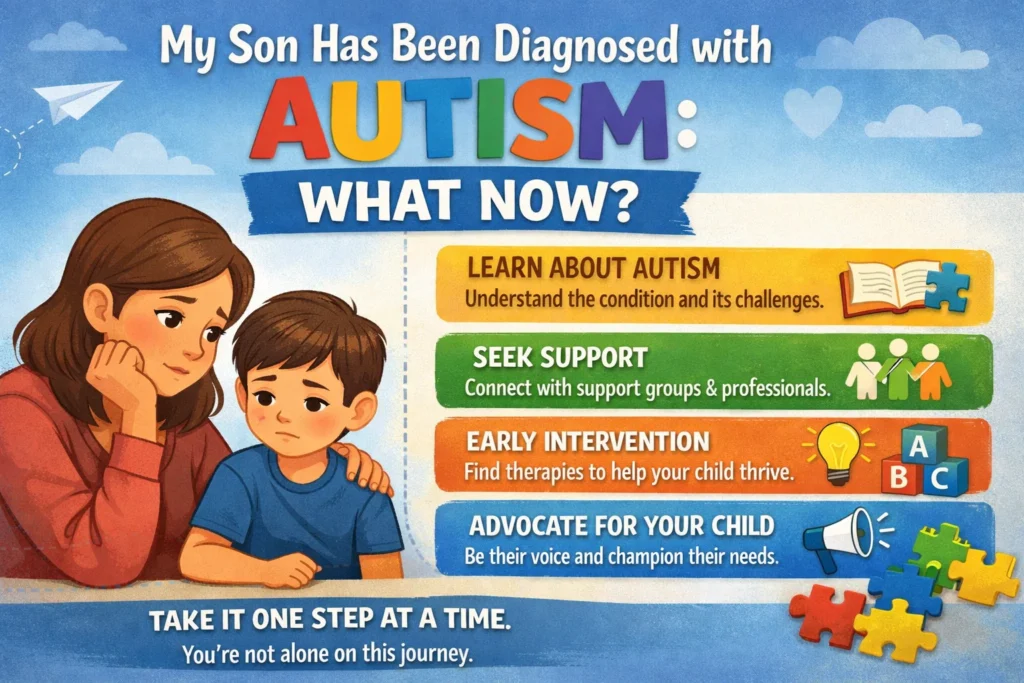
My son has been diagnosed with autism: what now?
A support plan for mothers who are beginning this journey.
Receiving a diagnosis of Autism Spectrum Disorder (ASD) for your child can be one of the most impactful moments of motherhood. Faced with an avalanche of feelings, doubts, and technical information, it’s common to feel fear, frustration, or even emotional paralysis.
Therefore, if you are going through this moment, this article was written especially for you. Here, we offer a humanized support plan, based on scientific evidence and with practical guidance. The goal is to help you care for your child—and yourself—with more clarity, confidence, and hope.
1. Validating what you are feeling is the first step.
First and foremost, it’s crucial to acknowledge and accept the emotions that arise with the diagnosis. It’s perfectly normal to feel fear, sadness, denial, guilt, or confusion.
Ultimately, an autism diagnosis often disrupts dreams, changes routines, and confronts the family with a new reality. However, know that feeling all of this is not a sign of weakness —it’s a sign of love.
You don’t need to understand everything right now. On the contrary, respecting your emotional pace and seeking support is what makes this journey lighter and more achievable.
💡 Tip: Seeking psychological support for yourself can be just as important as starting therapy for your child. Taking care of your mental health strengthens the whole family.
2. What does an autism diagnosis mean?
Autism Spectrum Disorder is a neurodevelopmental condition that primarily impacts three areas:
Verbal and nonverbal communication;
Social interaction;
Repetitive behaviors and restricted interests.
In other words, autism affects how a child perceives and relates to the world around them. However, the spectrum is very broad. This means that each child has unique characteristics, with different levels of abilities, difficulties, and support needs.
🔎 Not every child with autism is nonverbal. Similarly, not every verbal child will have complete autonomy. The diagnosis does not determine destiny — it only guides the path.
Levels of support in autism
According to the DSM-5 , ASD is classified into three levels:
Level 1: Requires light support;
Level 2: Requires substantial support;
Level 3: Requires very substantial support.
This classification is important because it helps define the type and intensity of interventions. However, it is essential to remember that this definition may change over time , depending on the child’s development.
3. Where to begin? The importance of early intervention.
Right now, the most common question mothers have is: what to do now?
The scientific answer is clear: the earlier interventions begin, the greater the chances of the child’s development . This is because, in the first years of life, the brain is in a period of intense plasticity, meaning it is more receptive to stimuli and learning.
Therefore, early intervention becomes a fundamental tool for progress.
Professionals who make up the multidisciplinary team:
Psychologist (with training in ABA – Applied Behavior Analysis):
Works on developing cognitive, social, and adaptive skills, as well as helping to reduce dysfunctional behaviors. ABA is one of the most scientifically supported approaches in the treatment of autism.Speech-language pathologist:
Works to stimulate verbal and non-verbal language, as well as addressing aspects such as comprehension, functional communication, and selective eating, when present.Occupational Therapist (OT):
Works on motor skills, sensory integration, body organization, and activities of daily living, such as dressing, feeding, using the toilet, among others.Neuropediatrician or Child Psychiatrist:
This professional is responsible for medical follow-up. They can prescribe tests, medications (when necessary), and adjust treatments according to the child’s development.
💡 It’s important to remember that each case is unique. Therefore, the treatment plan must be individualized and adapted to the needs of the child and the family.
Frequency and duration of treatment
In general, studies recommend between 10 and 40 hours of intensive intervention per week , especially up to 6 years of age.
However, this does not mean that all of these hours must be spent in clinics. Some of this time can be used at home, with guidance from professionals and active participation from the family.
Furthermore, it is essential to respect the child’s limits and avoid overloading them , both for the child and for yourself.
4. You are not alone: a support network is essential.
During this process, many mothers feel like they are carrying the weight of the world alone. However, you don’t have to—and shouldn’t—face this alone .
Building a support network can include:
Family members who actively participate in the daily routine;
Parent groups for children with autism (in-person or online);
Support institutions, NGOs and specialized clinics;
The school, which should be a partner in the inclusion process.
Furthermore, it’s essential that you take care of your mental health . After all, when a mother is emotionally strong, she can make better decisions and offer more secure support to her child.
5. There is hope — and it grows with every achievement.
Even if the diagnosis comes with terms like “level 3,” “nonverbal,” or “requires significant support,” this does not mean there will be no progress .

On the contrary, many children with autism develop incredible skills over time, provided they receive the right stimulation.
Research indicates that early and intensive intervention can lead to significant improvements in communication, behavior, socialization, and autonomy.
📘 Studies such as those by Lovaas (1987) and the Early Start Denver Model (Rogers & Dawson) reinforce that up to 50% of young children who undergo structured intervention show substantial progress.
Therefore, every small step forward is a great victory. And every victory opens up new possibilities for the future.
In conclusion: you’re starting a new phase—and you’re not alone.
Although the beginning is challenging, this journey can also be transformative. With love, information, support, and persistence, you and your child will build a possible path—one full of meaning.
Trust the process, allow yourself to learn, and remember that you are doing your best .
💬 “Your child doesn’t need to be like anyone else. They need to be who they are — with the support of the person who believes in them every day: you.”
