
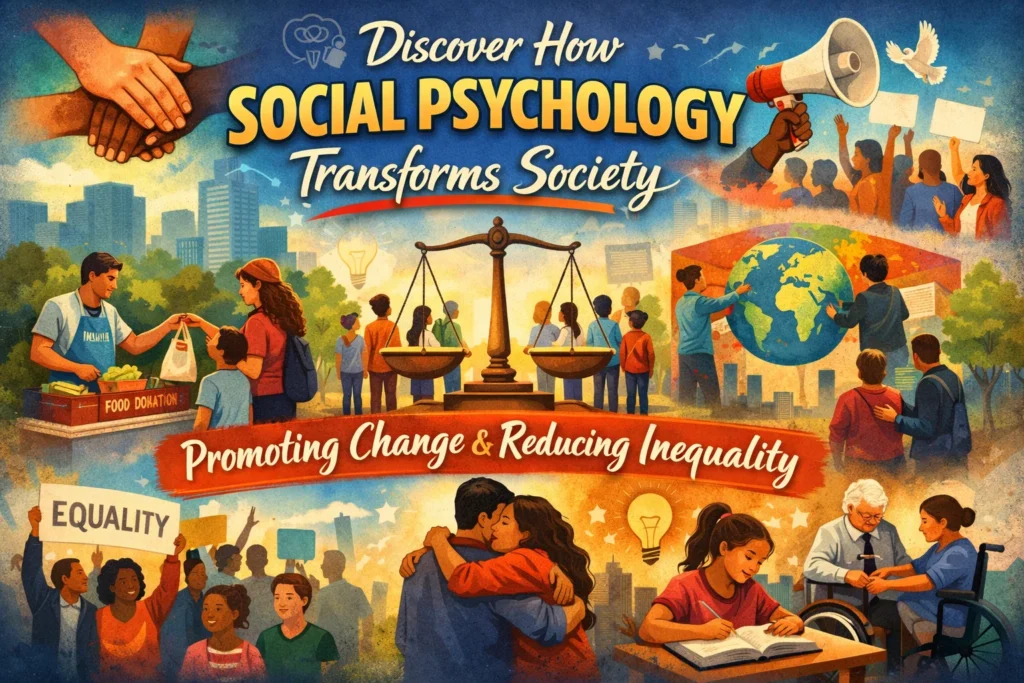
Social Psychology: Catalyzing Social Transformation Through Understanding Human Connection
Social psychology illuminates one of humanity’s most profound paradoxes: we are simultaneously shaped by society and shapers of it. This dynamic field examines how our thoughts, feelings, and behaviors emerge from social contexts while also investigating how individuals and groups drive social change. By understanding the invisible forces that guide collective life—from subtle social norms to entrenched systems of inequality—social psychology equips us to build more just, equitable, and humane societies.
Far from abstract theorizing, social psychology offers practical tools for addressing the urgent challenges that define our era: polarization and prejudice, health crises and misinformation, violence and exclusion. This article explores what social psychology reveals about human nature and how its insights contribute to meaningful social transformation.
Understanding Social Psychology
Social psychology investigates the intricate dance between individuals and their social worlds. Unlike psychology that focuses primarily on internal mental processes or sociology that examines large-scale social structures, social psychology occupies the vital space between—exploring how social contexts shape individual psychology and how individuals collectively create social reality.
This field examines questions that affect daily life in profound ways. How do we form impressions of others, often within seconds of meeting them? Why do people conform to group norms even when they privately disagree? What psychological mechanisms sustain prejudice across generations? How do ordinary people become capable of extraordinary cruelty or courage? What conditions allow misinformation to spread like wildfire through communities?
Social psychologists study phenomena that might seem inevitable or natural but are actually products of specific social arrangements. Stereotypes that feel like obvious truths reflect cognitive shortcuts influenced by cultural narratives. Status hierarchies that appear fixed are maintained through subtle interpersonal dynamics. Behaviors that seem like individual choices often follow predictable patterns shaped by social influence.
Consider how stereotypes operate. They’re not simply inaccurate beliefs that education alone can correct. Social psychology reveals them as complex phenomena involving categorization processes that help us navigate information overload, motivated reasoning that protects valued identities, and social structures that make certain patterns visible while rendering others invisible. Understanding this complexity is essential for designing interventions that actually reduce prejudice rather than inadvertently reinforcing it.
Social psychology also illuminates our capacity for change. While individuals are shaped by social forces, they aren’t passive recipients of social influence. People resist unjust norms, create counter-narratives, build alternative communities, and mobilize for collective action. Social psychology examines how these processes unfold—what conditions make resistance possible, how social movements gain momentum, and what strategies effectively challenge entrenched inequalities.
Pathways to Social Transformation
Social psychology’s contribution to social change operates through multiple interconnected pathways. By revealing the psychological mechanisms that sustain harmful social patterns, this field enables targeted interventions that address root causes rather than surface symptoms.
Understanding prejudice and discrimination represents one crucial avenue. Social psychological research has revealed that overt bigotry, while still damaging, represents only part of the picture. Implicit biases—automatic associations and assumptions that operate outside conscious awareness—influence decisions about hiring, healthcare, criminal justice, and countless other domains. These biases affect even people who consciously reject prejudice and sincerely believe in equality.
This knowledge has catalyzed practical interventions. Organizations now implement structured decision-making processes that reduce opportunities for bias to influence outcomes. Medical schools train future physicians to recognize how racial stereotypes can lead to disparities in pain management and treatment recommendations. Police departments are adopting practices informed by research on how stress and split-second decisions activate stereotypical associations.
Social psychology also addresses violence—both interpersonal and structural. Research on domestic violence reveals how isolation, power imbalances, and cycles of tension and reconciliation trap victims in dangerous situations. Understanding these dynamics informs interventions that address the full complexity of abusive relationships rather than simply asking why victims don’t leave.
Urban violence similarly benefits from social psychological insight. Community violence prevention programs increasingly draw on research about group dynamics, identity, respect, and retaliation to interrupt cycles of violence. Rather than relying solely on deterrence, these programs address the social contexts that make violence feel necessary or inevitable to those involved.
Social exclusion and inequality persist partly through psychological mechanisms that social psychology illuminates. Research on system justification reveals how even people disadvantaged by current arrangements sometimes defend those systems, perceiving them as fair or inevitable. Understanding this phenomenon helps advocates develop messaging that challenges these beliefs effectively.
Public health challenges increasingly require social psychological expertise. The COVID-19 pandemic starkly demonstrated that controlling infectious disease depends not just on medical technology but on collective behavior. Social psychologists contributed to understanding vaccine hesitancy, designing effective public health communication, addressing pandemic fatigue, and supporting communities through prolonged uncertainty and loss.
Applied Social Psychology Across Contexts
The principles of social psychology find application across remarkably diverse settings, each offering opportunities to reduce harm and expand human flourishing.
Educational contexts benefit enormously from social psychological insight. Bullying prevention programs grounded in understanding of group dynamics, social hierarchies, and bystander behavior prove more effective than approaches treating bullying as simply individual misbehavior. Interventions addressing stereotype threat—the anxiety that arises from awareness of negative stereotypes about one’s group—have helped close achievement gaps by removing psychological barriers to performance.
Programs promoting inclusive school climates draw on research about intergroup contact, emphasizing conditions that reduce prejudice: equal status, common goals, institutional support, and opportunities for genuine relationship. These aren’t just feel-good initiatives; research demonstrates their impact on both social cohesion and academic outcomes.
Public health increasingly recognizes that health behaviors unfold in social contexts. Social psychologists contribute to designing campaigns that account for how social norms influence decisions, how trust in messengers affects receptiveness to information, and how community networks can either amplify or impede health-promoting behaviors.
During the pandemic, social psychologists helped health authorities understand why mask-wearing became polarized along political lines, how to counter misinformation without inadvertently amplifying it, and how to sustain motivation for protective behaviors as the crisis stretched on. Their expertise proved essential for translating epidemiological knowledge into actual behavioral change.
Organizational settings apply social psychology to improve workplace dynamics, leadership effectiveness, and organizational culture. Research on diversity and inclusion reveals that good intentions aren’t sufficient—organizations must actively address how power operates, whose voices are heard, and how decisions get made. Social psychologists help organizations move beyond surface-level diversity initiatives to examine and transform the systems that produce inequity.
Social movements draw on social psychological research to develop effective strategies for mobilization and persuasion. Understanding how people develop collective identities, what motivates sustained activism despite obstacles, and how movements frame issues to resonate with potential supporters all inform advocacy work. Research on attitude change guides activists in crafting messages that genuinely shift perspectives rather than simply preaching to those already converted.
Public policy increasingly incorporates social psychological evidence. Policymakers designing interventions to reduce recidivism, increase civic participation, promote environmental conservation, or address any number of social challenges benefit from understanding the psychological factors that influence behavior. “Nudge” approaches that subtly alter decision contexts to promote prosocial choices represent one application, though social psychology also reveals the limitations of such interventions and the need for structural change.
The Transformative Power of Social Psychological Knowledge
What makes social psychology particularly valuable for social transformation is its dual focus on understanding and change. It doesn’t simply describe social reality as fixed and inevitable but examines the psychological processes through which social arrangements are constructed, maintained, and potentially transformed.
Research documenting how misinformation spreads illuminates why fact-checking alone often fails to correct false beliefs. Social psychological work reveals that people process information through identity-protective cognition—evaluating claims based partly on whether accepting them would threaten valued group identities or worldviews. This knowledge helps communicators develop strategies that present accurate information in ways less likely to trigger defensive responses.
Studies of intergroup relations reveal conditions under which contact between different groups reduces prejudice versus when it reinforces stereotypes. This knowledge guides the design of integration initiatives, diversity programs, and community-building efforts that actually improve relations rather than generating backlash.
Research on collective action explains what motivates people to join social movements, how movements sustain momentum, and what factors lead to successful versus failed attempts at change. This understanding empowers advocates working for justice to channel their efforts strategically.
Social psychology contributes to strengthening democracy itself by examining how citizens form political attitudes, what influences civic participation, how polarization develops, and what conditions support constructive dialogue across difference. In an era of democratic fragility worldwide, these insights prove invaluable.
The Social Psychologist’s Role
Social psychologists function as bridges between individual experience and collective reality. Their work involves both understanding and intervention—rigorously examining social phenomena while also developing and implementing strategies for positive change.
In practice, this takes many forms. Social psychologists conduct community assessments to understand local social dynamics and needs. They design and evaluate programs addressing specific social problems—from reducing youth violence to promoting workplace inclusion to supporting refugees’ integration. They collaborate with NGOs, government agencies, schools, healthcare systems, and community organizations to translate research insights into practical applications.
These professionals contribute to policy development by bringing evidence about what actually changes behavior and improves outcomes, not just what sounds appealing or confirms existing assumptions. They train others—educators, healthcare providers, law enforcement, community leaders—to recognize and counteract biases and to employ practices that promote equity.
Social psychologists also engage in advocacy, using their expertise to challenge unjust policies and practices. They provide expert testimony, contribute to public discourse, and participate in movements for social justice. Their unique contribution lies in illuminating the psychological dimensions of social problems—revealing how individual-level and system-level factors interact to produce outcomes.
Consider a social psychologist developing employment programs for marginalized populations. Rather than attributing unemployment solely to individual deficits or solely to discrimination, they examine how stereotypes influence hiring decisions, how social networks provide access to opportunities, how past experiences of discrimination affect job-seeking behavior, and how organizational practices either include or exclude. This multilevel analysis enables interventions that address the full complexity of the problem.
Building a More Just World
Social psychology matters because it reveals that much of what seems natural, inevitable, or unchangeable about social life is actually contingent—shaped by specific historical conditions, cultural narratives, institutional arrangements, and collective practices. This recognition is profoundly hopeful: if social patterns are constructed, they can be reconstructed.
The field demonstrates that reducing inequality, challenging prejudice, preventing violence, strengthening communities, and building more democratic societies are not merely moral aspirations but achievable goals supported by scientific understanding. Social psychology provides both vision—evidence that people and societies can change—and roadmap—knowledge about the conditions that facilitate such change.
For anyone concerned about the state of our world, whether focused on specific issues or broader questions of social justice, social psychology offers invaluable resources. It helps us understand why problems persist despite good intentions and what actually drives meaningful change. It reveals leverage points for intervention and warns against approaches that sound appealing but prove ineffective or counterproductive.
Most fundamentally, social psychology reminds us that we are inherently social beings whose fates are intertwined. The challenge isn’t to transcend our social nature but to build social arrangements that bring out our better angels—that foster cooperation over competition, inclusion over exclusion, justice over exploitation, and shared humanity over dehumanizing division.
Understanding how society shapes us is the first step toward consciously shaping society. That’s the promise social psychology extends—not easy answers, but the knowledge and tools to participate more effectively in the ongoing work of creating a world worthy of our highest aspirations.
