
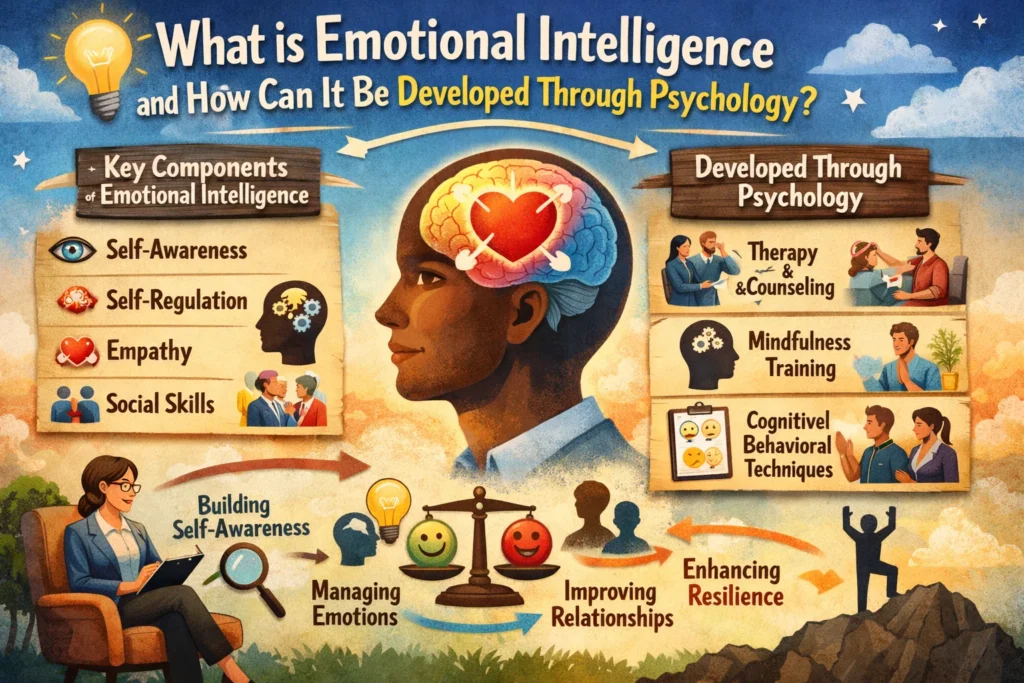
What is emotional intelligence and how can it be developed through psychology?
Currently, there is much talk about the importance of emotional intelligence for personal and professional success. However, doubts still exist about what this concept really means and how it can be developed with the support of psychology.
In this article, you will understand what emotional intelligence is and how psychology can help improve it, promoting more balance and well-being in your life.
What is emotional intelligence?
Simply put, it’s the ability to recognize, understand, and manage one’s own emotions , as well as to deal healthily with the feelings of others.
This concept was popularized by psychologist Daniel Goleman , who highlighted five key competencies of emotional intelligence:
Emotional self-awareness — perceiving and understanding your emotions.
Self-control — knowing how to regulate impulses and behaviors.
Self-motivation — staying motivated, even in the face of challenges.
Empathy — recognizing and respecting the emotions of others.
Social skills — interacting well, building healthy relationships.
For this reason, those who develop emotional intelligence tend to make more conscious decisions, have better relationships, and cope better with stress.
What is the relationship between emotional intelligence and psychology?
These two areas are deeply connected, as psychologists possess the appropriate tools to help develop these skills.
Through psychotherapy , the individual can:
Explore and understand your emotions;
Identify dysfunctional behavioral patterns;
Learning emotion regulation strategies;
Strengthening self-esteem and assertiveness.
Furthermore, several psychological approaches, such as Cognitive Behavioral Therapy (CBT) , are effective in improving self-awareness and emotional control.
🔗 Read also: How psychology helps with self-knowledge
How can psychology develop emotional intelligence?
Although some people already possess more developed emotional skills, the good news is that emotional intelligence can be learned and improved throughout life .
Below are some ways to work on this aspect with the support of psychology:
➡ Participating in psychotherapy : allows you to deepen your self-knowledge and develop emotional regulation skills.
➡ Practicing self-observation helps to identify emotional triggers, automatic thoughts, and impulsive reactions.
➡ Developing empathy : In therapy, individuals learn to better understand the feelings of others, improving interpersonal relationships.
➡ Developing social skills : Psychologists can help build communication, active listening, and assertiveness skills.
➡ Managing stress : techniques such as mindfulness, conscious breathing, and relaxation are frequently used by psychologists to assist in this process.
🔗 See also: What is mindfulness and how can it help your mental health?
What are the benefits of having good emotional intelligence?
Developing emotional intelligence through psychology provides numerous benefits, impacting various areas of life:
✅ Improved interpersonal relationships;
✅ Increased resilience in the face of adversity;
✅ Reduced stress and anxiety;
✅ Greater clarity in decision-making;
✅ Development of leadership and empathy.
In short, those who work on their emotional intelligence tend to feel more balanced, productive, and satisfied with themselves.
When should you seek psychological help to develop emotional intelligence?
If you notice difficulties in dealing with intense emotions, impulsive reactions, or relationship problems, this may be the ideal time to seek psychological support.
Furthermore, those who wish to enhance their leadership skills or improve their professional performance can also benefit from developing emotional intelligence with specialized support.
🔗 Read also: When should you seek a psychologist?
Conclusion
As we have seen, emotional intelligence and psychology go hand in hand. Psychotherapy is a valuable tool for those who wish to better understand their emotions, improve self-control, and strengthen personal and professional relationships.
Therefore, if you want to invest in your emotional growth and achieve a more balanced life, consider seeking a psychologist. After all, taking care of your emotional health is just as important as taking care of your physical health .
