
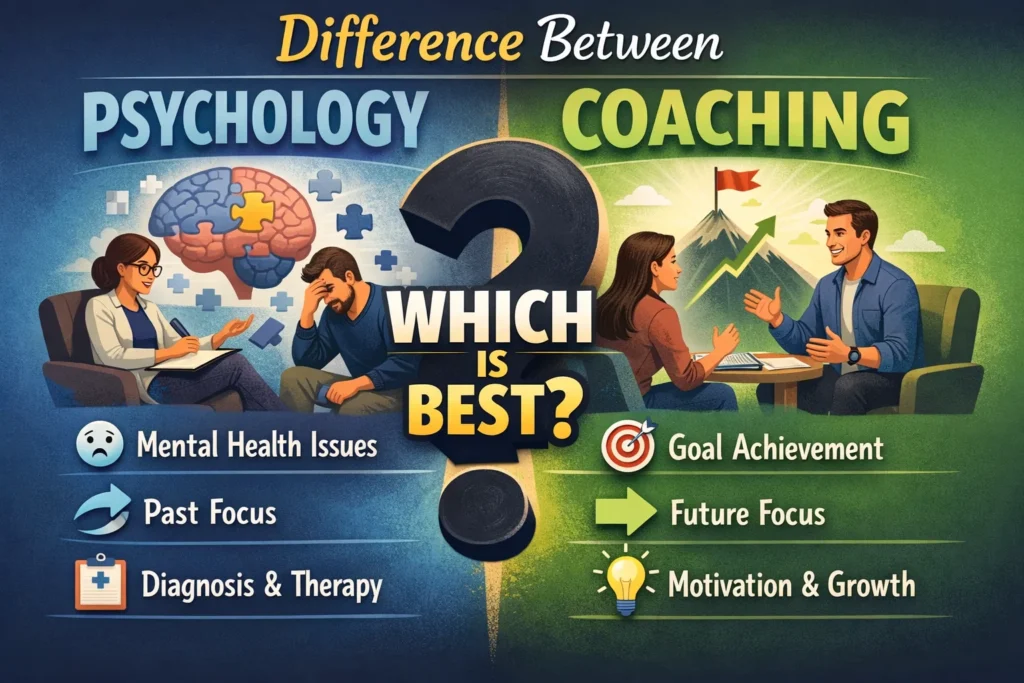
Difference between psychology and coaching: which is best?
In recent years, interest in personal and emotional development has grown considerably. As a result, many people have begun seeking alternatives to cope with their difficulties, improve their professional performance, or find more balance in life. In this context, two very popular approaches have emerged: psychology and coaching.
But what exactly is the difference between psychology and coaching ? And more importantly: in what situations is each one indicated?
In this article, you will understand what distinguishes these two practices, their objectives, training, and when to choose one or the other.
What is psychology?
Psychology is a recognized and regulated science whose main objective is to study human behavior, mental processes, and emotions. A psychologist, a professional with a university degree and registration with the CRP (Regional Council of Psychology), is qualified to perform diagnoses, treatments, and clinical interventions.
Furthermore, psychotherapy — one of the best-known areas of psychology — helps patients understand their emotions, traumas, behavioral patterns, and emotional difficulties.
Common indications for psychotherapy:
Depression, anxiety and mental disorders;
Family and marital conflicts;
Issues of self-esteem, grief, and identity;
Self-awareness and emotional maturity.
🔗 Read also: How can psychology help in the treatment of depression?
What is coaching?
Coaching, on the other hand, is neither a clinical practice nor a regulated science , but rather a guidance process focused on specific goals and results. The coach (the professional who leads the process) acts in a more targeted way towards developing skills, increasing performance, and achieving personal or professional objectives.
Although coaching has become quite popular, it is important to emphasize that it does not replace psychotherapy , especially in cases involving psychological distress, trauma, or emotional disorders.
Situations in which coaching can be useful:
Setting professional and personal goals;
Improved performance at work or in studies;
Leadership development and focus;
Career planning or professional transition.
🔗 See also: What is coaching and what is it for? – ICF Brazil
Difference between psychology and coaching: understand the main points.
To make it easier to understand, see below a practical comparison of the difference between psychology and coaching :
| Aspect | Psychology | Coaching |
|---|---|---|
| Base | Health science and human behavior | Results-focused mentoring process |
| Training | Bachelor’s degree in Psychology + registration with the CRP (Regional Psychology Council). | Open courses, with no requirement for formal training. |
| Focus | Mental health, emotions, trauma, and self-knowledge. | Goals, performance, productivity, and a focus on results. |
| Indication | Disorders, crises, psychological suffering, therapy | Career planning, focus, personal performance |
| Duration | It can be medium or long term. | Short term, with pre-defined meetings. |
| Regulation | Yes (CFP – Federal Council of Psychology) | There is no official regulation. |
Psychology or coaching: which is best?
The answer depends on your goal.
➡ If you are facing deep emotional issues, internal conflicts, psychological suffering, or wish to deepen your self-knowledge , psychotherapy is the most suitable path.
On the other hand, if you are looking for focus, organization, clarity of goals, or want to develop specific skills for a phase of life or career , coaching can be useful — provided it is conducted by an ethical and qualified professional.
However, it’s important to highlight that coaching does not treat mental disorders . In situations such as depression, anxiety, or intense stress, only a psychologist or psychiatrist can offer the appropriate support.
Conclusion
Despite some similarities in their objectives — such as personal development — the difference between psychology and coaching is clear: while psychology is based on scientific studies and seeks to care for mental health in a profound way, coaching focuses on goals and performance, with a focused and non-clinical approach.
Both approaches can be complementary, provided they are used responsibly and in appropriate contexts. The most important thing is to recognize your needs and choose the path that will bring more balance, self-knowledge, and personal fulfillment.
