
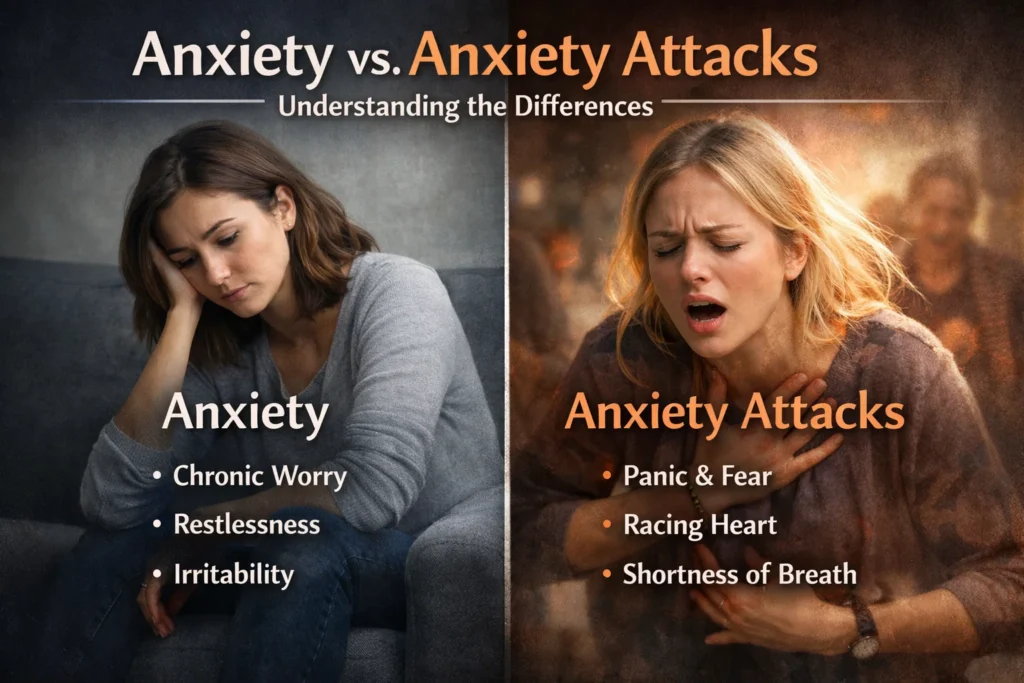
Anxiety vs. Anxiety Attacks: Understanding the Differences
What is the difference between anxiety and anxiety attacks, and why can understanding this distinction transform how you handle these challenges? Thousands of people confuse these two related yet essentially different phenomena, leading to inadequate coping strategies and unnecessary increased suffering. The truth is that, although connected, anxiety and anxiety attacks have distinct characteristics, durations, and impacts that require specific approaches.
Therefore, clearly identifying whether you are experiencing prolonged anxiety or an acute attack is essential for choosing the most effective management tools and seeking appropriate treatment. Anxiety can be a constant companion that gradually drains your energy and well-being, while attacks emerge as sudden and intense storms that momentarily steal your sense of control. In this article, we will explore these differences in depth, identify specific signs of each condition, and provide practical, evidence-based strategies to effectively deal with both situations, restoring quality of life and peace of mind.
What Is Anxiety: Understanding the Natural Response
Before identifying the difference between anxiety and anxiety attacks, we need to deeply understand what characterizes anxiety in its most basic form and when it becomes problematic.
Anxiety as an Adaptive Response
Anxiety is fundamentally a natural and evolutionarily adaptive emotional reaction to situations of uncertainty, challenge, or potential threat. It functions as an alert system that prepares the organism to deal effectively with future demands, mobilizing necessary physical and mental resources to face challenges.
At moderate and situational levels, anxiety is beneficial and even necessary. It motivates us to study for important tests, carefully prepare presentations, take precautions in potentially dangerous situations, and adequately plan significant events. For example, feeling anxiety before a job interview is completely normal and can even improve your performance by keeping you focused and prepared.
When Anxiety Becomes Chronic
However, the difference between anxiety and anxiety attacks begins to take shape when we examine chronic or pathological anxiety. This form of anxiety is characterized by excessive and persistent worry about multiple aspects of life, present on most days for at least six months. The intensity is disproportionate to actual circumstances, worries are difficult to control even with conscious effort, and there is significant interference with daily activities.
People with chronic anxiety frequently describe a constant sense of tension, negative anticipation of future events, difficulty relaxing even during leisure moments, and mental fatigue resulting from a permanent state of alertness. This condition develops gradually and remains relatively stable in intensity over time, fluctuating moderately but without dramatic peaks.
Characteristic Symptoms of Prolonged Anxiety
Chronic anxiety manifests through specific patterns that clearly differentiate it from acute attacks. Emotional symptoms include excessive worry about the future, frequent irritability and impatience, difficulty concentrating on tasks, sensation of restlessness or being “on edge,” and diffuse fear without specific focus.
Physically, prolonged anxiety is characterized by muscle tension especially in neck and shoulders, fatigue even with adequate sleep, recurrent tension headaches, gastrointestinal disturbances such as irritable bowel syndrome, and sleep disturbances including difficulty falling asleep or non-restorative sleep.
What Are Anxiety Attacks: Acute and Intense Episodes
To fully comprehend the difference between anxiety and anxiety attacks, we need to examine in detail the characteristics that define these sudden and overwhelming episodes.
Defining Characteristics of Attacks
Anxiety attacks are sudden and intense episodes of extreme fear or discomfort that reach peak intensity rapidly, usually within minutes. Unlike prolonged anxiety that develops gradually, attacks emerge abruptly, often without prior warning or identifiable trigger.
The intensity of symptoms during attacks is significantly greater than in chronic anxiety. Many people describe the experience as terrifying, with sensations of imminent death, loss of control, or “going crazy.” Although extremely uncomfortable, most anxiety attacks last between 10 and 30 minutes, rarely exceeding one hour.
Overwhelming Physical Symptoms
The difference between anxiety and anxiety attacks becomes dramatically evident in physical symptoms. During attacks, the body experiences intense tachycardia or palpitations that make the heart seem about to explode, excessive sweating especially on palms, uncontrollable trembling or shaking throughout the body, sensation of suffocation or shortness of breath as if unable to breathe adequately, and chest pain or discomfort often confused with a heart attack.
Moreover, dizziness or sensation of impending fainting appears, nausea or intense abdominal discomfort, sensation of tingling or numbness especially in extremities, chills or sudden heat waves, and sensation of derealization or depersonalization where the person feels outside their own body or that the surrounding world is not real.
Emotional and Cognitive Symptoms
Beyond physical manifestations, anxiety attacks involve specific emotional and cognitive components. Intense and disproportionate fear dominates the experience, frequently focused on catastrophic worries such as fear of dying, fear of having a heart attack or stroke, fear of completely losing control, or fear of going crazy.
Cognitively, the person experiences rapid and disorganized thoughts, severe difficulty concentrating or logical reasoning, hypervigilance to bodily sensations interpreting any symptom as a sign of imminent catastrophe, and sensation of unreality as mentioned previously.
Key Differences: A Detailed Comparison
Systematically understanding the difference between anxiety and anxiety attacks facilitates correct recognition of the experience you are having and the choice of appropriate coping strategies.
Temporal Duration
One of the clearest distinctions relates to the duration of each phenomenon. Chronic anxiety persists for prolonged periods – weeks, months, or even years – with moderate fluctuation but relatively constant presence. It accompanies the person throughout the day, intensifying in certain situations but rarely disappearing completely.
In contrast, anxiety attacks are acute and temporary episodes. Although intensely uncomfortable, they reach peak in approximately 10 minutes and generally resolve within 20 to 30 minutes. After the attack, the person often feels exhausted but the intense physical symptoms diminish significantly.
Symptom Intensity
Intensity represents another easily identifiable difference between anxiety and anxiety attacks. Chronic anxiety is characterized by symptoms of mild to moderate intensity that, although draining, allow the person to continue functioning in daily activities, even with discomfort. The person works, studies, and maintains commitments, although with more effort and lower quality of life.
Anxiety attacks, on the other hand, involve symptoms of severe and debilitating intensity that often paralyze the person during the episode. Many describe the impossibility of continuing what they were doing, needing to stop completely until symptoms diminish. The intensity is so dramatic that many people seek emergency medical care believing they are having a heart attack or another medical emergency.
Presence or Absence of Triggers
The difference between anxiety and anxiety attacks also manifests in relation to triggers. Chronic anxiety generally relates to identifiable worries – work, finances, health, relationships – even when the intensity of worry is disproportionate. The person can name what they are anxious about, although recognizing the worry is excessive.
Anxiety attacks frequently arise unexpectedly, without apparent or identifiable trigger. The person may be performing a routine activity when suddenly symptoms explode. In some cases, attacks may have specific triggers like enclosed spaces or crowds, but even then the response is disproportionate to the stimulus.
Impact on Functionality
Finally, the impact on daily functionality differs significantly. Chronic anxiety gradually affects quality of life, causing progressive deterioration in professional performance, constant mental fatigue, gradual avoidance of uncomfortable situations, and cumulative impact on relationships.
Anxiety attacks cause temporary but intense incapacitation during episodes, development of anticipatory anxiety about future attacks, avoidance of locations where attacks have already occurred, and psychological impact related to fear of losing control publicly.
How to Deal with Chronic Anxiety
Understanding the difference between anxiety and anxiety attacks allows developing specific strategies for each situation. For chronic anxiety, long-term approaches focus on sustainable lifestyle changes and thought patterns.
Regular Physical Exercise
Physical activity represents one of the most effective interventions for prolonged anxiety. Aerobic exercises like walking, running, swimming, or cycling significantly reduce anxious symptoms through multiple mechanisms – release of endorphins that improve mood, reduction of stress hormones like cortisol, improvement of sleep quality, and increase in self-efficacy and confidence.
Studies demonstrate that moderate-intensity exercises for 30 minutes, five times weekly, produce effects comparable to anxiolytic medications in mild to moderate cases. The important thing is to choose activities you genuinely enjoy, increasing the likelihood of long-term maintenance.
Relaxation and Mindfulness Techniques
Regular relaxation and mindfulness practices teach the nervous system to return more easily to a state of calm. Progressive muscle relaxation, practiced daily for 15-20 minutes, reduces chronic physical tension that perpetuates anxiety. Mindfulness meditation cultivates the capacity to observe anxious thoughts without engaging with them, creating mental space between you and your worries.
Diaphragmatic breathing practiced regularly – not just during crises – recalibrates the autonomic nervous system, reducing general stress reactivity. These practices work cumulatively; results become more evident after weeks of consistent practice.
Organization and Task Management
Anxiety frequently intensifies when the person feels overwhelmed and without control. Developing effective organization and prioritization systems reduces mental overload that feeds excessive worries. Break large projects into smaller, manageable steps, establish clear priorities using methods like the urgent-important matrix, delegate tasks when possible, and establish realistic limits about what can be accomplished.
Moreover, practice “mental hygiene” by dedicating specific times for worries instead of allowing them to invade the entire day. Some therapists recommend a daily 20-minute “worry period” where you deliberately examine worries, postponing them to this moment when they arise at other times.
Cognitive-Behavioral Psychotherapy
Cognitive-Behavioral Therapy (CBT) represents first-line treatment for chronic anxiety with decades of scientific evidence proving efficacy. CBT teaches identification and modification of distorted thought patterns that fuel anxiety, development of specific coping skills, gradual exposure to avoided situations, and restructuring of dysfunctional beliefs about uncertainty and control.
Working with a psychologist specialized in CBT offers personalized tools based on your specific triggers and patterns, plus professional support during the change process.
How to Deal with Anxiety Attacks
While strategies for chronic anxiety focus on long-term changes, dealing with anxiety attacks requires immediate intervention techniques that rapidly reduce the intensity of acute symptoms.
Breath Control: Immediate Tool
During anxiety attacks, hyperventilation dramatically intensifies physical symptoms, creating a vicious cycle. Deliberately controlling breathing interrupts this cycle by activating the parasympathetic nervous system responsible for relaxation.
The most effective technique is square breathing: inhale through your nose counting slowly to four, hold your breath for four, exhale through your mouth for four, and pause for four before restarting. Repeat this cycle focusing all attention on counting and the sensation of breathing. Initially it may be challenging, but even imperfect directed breaths help interrupt hyperventilation.
Grounding Techniques: Reconnecting with the Present
Anxiety attacks frequently involve sensations of derealization or dissociation. Grounding techniques reconnect you with the present moment through concrete sensory stimuli, interrupting spirals of catastrophic thinking.
The 5-4-3-2-1 technique is particularly effective: identify five things you can see around you, four you can touch (physically touch them), three you can hear, two you can smell, and one you can taste. Do this slowly, mentally describing each sensation in detail.
Other techniques include holding a cold object like an ice cube focusing intensely on the sensation, stepping firmly on the ground feeling the contact of feet, or splashing cold water on your face.
Acceptance Instead of Resistance
Paradoxically, trying to fight an anxiety attack often intensifies symptoms. Desperate resistance increases tension and fear, feeding the cycle. Acceptance-based approaches teach that, although extremely uncomfortable, anxiety attacks are not dangerous and always pass.
Practice self-affirmations like “This is anxiety, not real danger,” “I’ve been through this before and it passed,” “Symptoms always peak and then diminish,” and “I can tolerate this temporary discomfort.” Accepting the attack without desperately fighting it often reduces its duration and intensity.
Moving Away from Overstimulating Situations
If possible, temporarily move away from very stimulating environments during attacks. Crowds, loud noises, and intense lights can intensify symptoms. Find a calmer and quieter space where you can practice breathing and grounding without distractions or social pressure.
However, avoid developing a pattern of permanent avoidance of locations where attacks occurred. Moving away during crises is an acute management strategy; chronic avoidance perpetuates the problem by developing agoraphobia.
The Role of Cognitive-Behavioral Therapy
When we explore the difference between anxiety and anxiety attacks in the context of treatment, CBT stands out for its proven efficacy for both conditions, although with slightly different focuses.
CBT for Chronic Anxiety
In treating prolonged anxiety, CBT concentrates on identifying and modifying chronic worry schemas, challenging dysfunctional beliefs about need for certainty and control, developing tolerance for uncertainty through gradual exercises, and restructuring catastrophic thoughts replacing them with more realistic evaluations.
For example, someone with excessive worry about professional performance learns to identify automatic thoughts like “If I make a mistake, I’ll be fired,” question evidence for this belief, and develop it into a more balanced evaluation like “Occasional mistakes are normal and generally don’t result in termination.”
CBT for Anxiety Attacks
For attacks, CBT uses specific techniques including detailed psychoeducation about the physiology of attacks removing catastrophic interpretations, interoceptive exposure where the person deliberately induces physical sensations similar to attacks in a safe environment learning they are not dangerous, cognitive restructuring of catastrophic interpretations of symptoms, and gradual exposure to situations avoided due to fear of attacks.
Interoceptive exposure is particularly powerful. For example, the therapist may ask the patient to run in place for two minutes to induce tachycardia and shortness of breath similar to the attack, learning that these sensations, although uncomfortable, do not cause feared outcomes like heart attack.
Illustrative Clinical Case
Maria, 32 years old, suffered from chronic anxiety for years and occasional anxiety attacks. She avoided highway driving after having an attack while driving, developing constant worry about having new attacks. Through CBT, Maria learned that her attacks resulted from catastrophic interpretation of normal physical sensations like mild tachycardia while driving.
Gradually, she practiced interoceptive exposure inducing tachycardia through exercise while visualizing driving, learning that palpitations do not cause loss of control. Subsequently, she practiced real exposure initially driving on nearby streets, then busier roads, and finally the highway. After 16 sessions, Maria regained confidence to drive and her attacks ceased completely.
When to Seek Professional Help
Understanding the difference between anxiety and anxiety attacks helps identify when self-management is not sufficient and professional intervention becomes necessary.
Signs That You Need Help
Seek a psychologist or psychiatrist when anxiety or attacks significantly interfere with work, studies, or daily responsibilities, damage important relationships, cause intense suffering that affects quality of life, lead to growing avoidance of situations and places, or when you resort to alcohol, drugs, or unprescribed medications to cope.
Moreover, if anxiety attacks become frequent (more than once weekly) or if you develop persistent fear of future attacks that limits your activities, this indicates possible panic disorder requiring specialized treatment.
Importance of Adequate Diagnosis
Qualified professionals can precisely differentiate between chronic anxiety, panic disorder, and other conditions that may mimic these problems. Some medical conditions like hyperthyroidism, heart problems, or hypoglycemia produce symptoms similar to anxiety and attacks.
Correct diagnosis ensures appropriate treatment and avoids prolonged unnecessary suffering. Psychologists use validated instruments and structured interviews to precisely assess the nature and severity of the condition.
Professional Treatment Options
Treatment may include individual psychotherapy focused on CBT or other evidence-based approaches, medication prescribed by a psychiatrist when symptoms are moderate to severe, or combination of psychotherapy and medication which often offers better results.
Early intervention significantly improves prognosis. The longer anxiety or attacks remain untreated, the more entrenched maladaptive patterns become and the greater the cumulative impact on life.
Final Considerations
Deeply understanding the difference between anxiety and anxiety attacks represents a fundamental step to regaining control over your mental health and quality of life. Although related, these phenomena have distinct characteristics, durations, intensities, and impacts that require specific coping strategies.
Chronic anxiety develops gradually, persists for long periods with moderate intensity, and benefits from long-term interventions like regular exercise, mindfulness practices, effective organization, and structured psychotherapy. Anxiety attacks arise abruptly, reach severe intensity rapidly but last short periods, and respond to immediate intervention techniques like breath control, grounding, and acceptance.
Cognitive-Behavioral Therapy demonstrates extraordinary efficacy for both conditions, offering personalized tools that fundamentally transform how you relate to anxiety and physical symptoms. Working with a specialized psychologist provides not only practical techniques but also deep understanding of mechanisms that perpetuate the problem.
It is crucial to recognize that neither chronic anxiety nor attacks are signs of personal weakness or character failure. They are legitimate conditions affecting millions of people and respond extraordinarily well to appropriate treatment. Seeking professional help when necessary demonstrates courage and self-care, not weakness.
Finally, remember that recovery is possible. With adequate understanding, appropriate tools, and professional support when necessary, you can regain control over your life, significantly reduce anxious symptoms, and develop resilience that protects against future episodes. The journey may seem challenging initially, but each small step toward well-being is profoundly worth the effort.
Read Also
- What is anxiety? Complete symptoms and diagnosis
- How psychology can help control anxiety
- Breathing techniques to control anxiety
- Panic disorder: symptoms and treatment
- When to seek a psychologist: important signs

[…] Em casos mais graves, a timidez pode evoluir para um transtorno mais sério, como o Transtorno de Ansiedade Social […]