
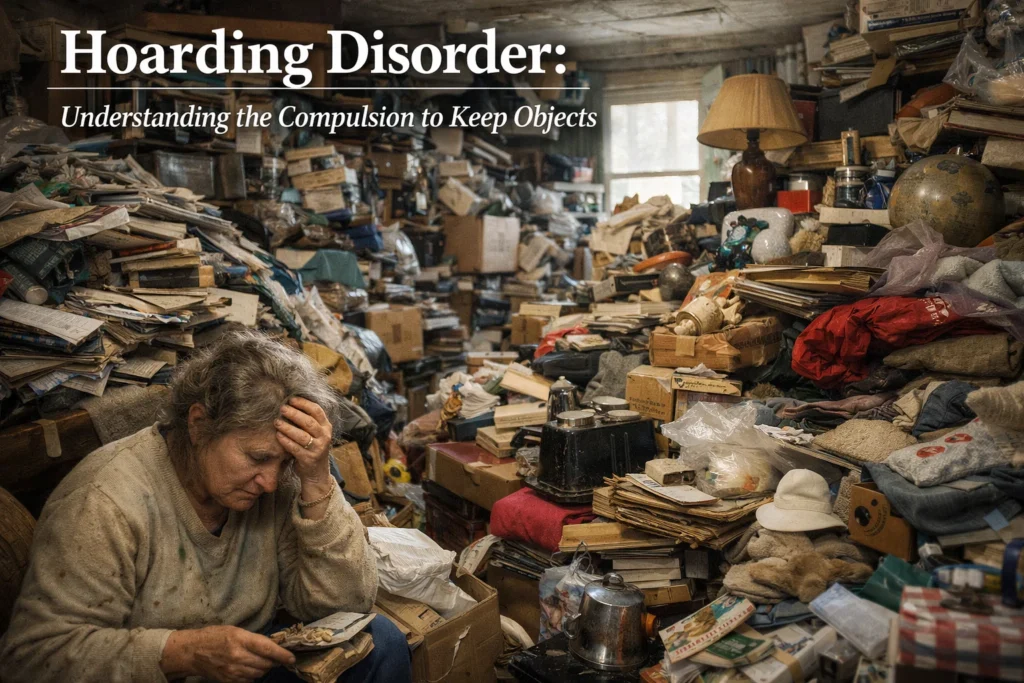
Hoarding Disorder: Understanding the Compulsion to Keep Objects
Why do some people develop an extreme inability to discard objects, transforming their homes into labyrinths of accumulated possessions? Hoarding Disorder represents a complex psychological condition where the difficulty of parting with possessions—regardless of their actual value—progressively overwhelms living spaces and significantly impairs quality of life. Far from simple messiness or collecting, this disorder involves profound emotional attachments to objects and intense distress at the thought of discarding them.
Therefore, understanding Hoarding Disorder—its psychological roots, manifestations, and evidence-based treatments—becomes essential for anyone struggling with this condition or supporting loved ones who face these challenges. The disorder typically develops gradually, often beginning in adolescence or early adulthood and worsening over decades if untreated. What starts as difficulty discarding items eventually creates dangerous living conditions, strained relationships, and significant functional impairment. In this article, we will explore the psychological foundations of Hoarding Disorder, examine how it manifests across different presentations, and present proven therapeutic approaches that can help individuals reclaim their living spaces and quality of life.
Understanding Hoarding Disorder: Clinical Definition
Before examining the causes and manifestations of hoarding, we must understand how this disorder is clinically defined and how it differs from related conditions.
Formal Diagnostic Criteria
Hoarding Disorder was officially recognized as a distinct mental health condition in the DSM-5 (Diagnostic and Statistical Manual of Mental Disorders, Fifth Edition) in 2013. Previously, it was considered a symptom of Obsessive-Compulsive Disorder, but research revealed it has unique characteristics warranting separate classification.
The disorder is characterized by persistent difficulty discarding or parting with possessions regardless of their actual value, perceived need to save items and distress associated with discarding them, and accumulation of possessions that congest active living areas and substantially compromise their intended use. These symptoms must cause clinically significant distress or impairment in social, occupational, or other important areas of functioning.
The key distinction from normal collecting lies in the pattern and consequences. Collectors typically organize items systematically, display them proudly, and maintain functionality of living spaces. People with Hoarding Disorder accumulate items chaotically, feel distressed by the clutter, and experience significant impairment as possessions overtake living areas.
Prevalence and Demographics
Research indicates that Hoarding Disorder affects approximately 2-6% of the population, making it more common than previously believed. The condition appears roughly equally across genders, though some studies suggest slightly higher rates among men. Hoarding typically emerges during adolescence or early twenties but often doesn’t come to clinical attention until middle age or later when accumulation has reached severe levels.
The disorder crosses all socioeconomic, educational, and cultural boundaries. However, certain factors correlate with higher risk, including family history of hoarding, presence of other mental health conditions like anxiety or depression, and history of traumatic experiences particularly involving loss.
Hoarding Versus Collecting
Understanding the difference between hoarding and collecting helps clarify when accumulation crosses into pathological territory. Collectors intentionally seek specific items that have value within a collecting community, organize and display items systematically, experience pride and enjoyment in their collections, and maintain living space functionality despite collections.
In contrast, people with Hoarding Disorder acquire items passively or impulsively without specific collecting goals, accumulate items chaotically without organization or display, experience distress and shame about their accumulation, and lose living space functionality as possessions overtake rooms. The emotional experience differs fundamentally—collectors find joy while hoarders experience distress.
Psychological Roots: Why Hoarding Develops
Hoarding Disorder rarely has a single cause. It typically emerges from complex interactions between psychological, neurobiological, and environmental factors.
Anxiety and Catastrophic Thinking
Many individuals with Hoarding Disorder experience profound anxiety about discarding items, driven by catastrophic predictions about future needs. They believe they might desperately need the item someday, even when the probability is extremely low. The thought “What if I need this and don’t have it?” generates intense anxiety that is only relieved by keeping the item.
This pattern reflects cognitive distortions common in anxiety disorders—overestimation of threat probability and underestimation of coping ability. The person genuinely believes that discarding an old magazine, broken appliance, or worn clothing could lead to devastating consequences. This isn’t rational choice but anxiety-driven compulsion that feels impossible to resist.
Additionally, perfectionism frequently contributes to hoarding. The person may believe they must find the “perfect” use for items or the “perfect” home for discarded possessions. Since perfect solutions rarely exist, nothing gets discarded. Decision-making becomes paralyzed by impossibly high standards.
Emotional Attachment and Identity
For many people with Hoarding Disorder, possessions carry profound emotional significance beyond their practical utility. Objects become extensions of personal identity, repositories of memories, or connections to important people and experiences. Discarding these items feels like discarding part of oneself or severing important emotional connections.
This attachment pattern often traces to adverse childhood experiences. Individuals who experienced emotional neglect may attach to objects as more reliable sources of comfort than people. Those who experienced material deprivation during formative years may hoard as protection against future scarcity. Objects become safer recipients of emotional investment than relationships that have proven unreliable or painful.
Research also reveals that many people with Hoarding Disorder experience possessions as extensions of their memory. They fear that discarding items means losing important memories or information. Since external memory (possessions) feels more reliable than internal memory, accumulation provides reassurance against forgetting.
Trauma and Loss
Traumatic experiences, particularly those involving loss, frequently precede or exacerbate hoarding behaviors. The death of a loved one, divorce, job loss, or other significant losses can trigger hoarding as an unconscious attempt to prevent further loss. If relationships and circumstances prove unreliable, possessions offer the illusion of control and permanence.
Following significant loss, some individuals begin saving items connected to the deceased person, then gradually extend this pattern to increasingly tangential items. The compulsion to keep things becomes generalized beyond its original trauma-related trigger, eventually encompassing virtually all possessions.
Trauma can also create hypervigilance about waste and need to preserve resources. Someone who experienced natural disaster, war, or severe poverty may develop persistent anxiety about scarcity, leading to compulsive saving “just in case.” Even when circumstances improve dramatically, the trauma-based anxiety persists, driving continued accumulation.
Neurobiological Factors
Brain imaging studies reveal that individuals with Hoarding Disorder show distinct patterns of brain activity compared to healthy controls. Regions involved in decision-making, particularly the anterior cingulate cortex and insula, show abnormal activation when people with hoarding contemplate discarding possessions.
These neurobiological differences suggest that hoarding isn’t simply willful refusal to clean or organize. The brain genuinely processes decisions about possessions differently, generating stronger emotional responses and greater difficulty with decision-making. This biological component explains why simply telling someone to “just throw things away” proves spectacularly ineffective.
Research also identifies deficits in executive function—cognitive processes involved in planning, organizing, and decision-making. People with Hoarding Disorder often struggle with categorization, attention, and working memory. These cognitive challenges make sorting through possessions genuinely overwhelming, independent of emotional attachments.
Relationship to Other Mental Health Conditions
While Hoarding Disorder is now recognized as a distinct condition, it frequently co-occurs with other mental health disorders. Approximately 75% of individuals with hoarding also meet criteria for mood or anxiety disorders. Depression is particularly common, sometimes as a cause contributing to lack of energy for organization, sometimes as a consequence of living in hoarded conditions.
Obsessive-Compulsive Disorder co-occurs in about 20% of hoarding cases. When present together, the conditions can reinforce each other—OCD-related perfectionism exacerbating difficulty making decisions about possessions. However, the majority of people with hoarding do not have OCD, confirming these are distinct though sometimes overlapping conditions.
Attention-Deficit/Hyperactivity Disorder (ADHD) also shows elevated rates among people with hoarding. Executive function deficits common in ADHD—difficulty with organization, planning, and follow-through—can contribute to accumulation and difficulty maintaining order.
Recognizing the Signs: How Hoarding Manifests
Understanding how Hoarding Disorder appears in daily life helps identify when accumulation has crossed from normal messiness into clinical disorder.
Difficulty Discarding Possessions
The hallmark symptom involves extreme difficulty discarding items regardless of their actual value. This includes saving newspapers, magazines, or junk mail for years, keeping broken or unusable items with vague plans to repair them someday, holding onto packaging, containers, and shopping bags, retaining worn-out clothing that no longer fits or is damaged beyond repair, and accumulating free items with no specific need or use.
The emotional experience of attempting to discard these items involves genuine distress, not mere laziness. People describe feeling anxious, guilty, or even panicked at the thought of throwing things away. They may spend hours agonizing over whether to keep or discard a single item, ultimately keeping it to relieve anxiety.
Cluttered Living Spaces
As difficulty discarding continues over months and years, possessions progressively overtake living spaces. Kitchen counters and tables become unusable for their intended purposes, bedrooms fill with items making beds inaccessible, bathrooms accumulate products and items reducing functionality, hallways narrow to single-file paths through accumulated possessions, and entire rooms become essentially inaccessible storage areas.
The clutter isn’t simply untidiness—it represents genuine obstruction of living space function. People may sleep in chairs because beds are covered with items, eat standing at counters because tables are buried, or avoid using bathrooms because they’re too cluttered for safe navigation.
Acquiring Behaviors
Many individuals with Hoarding Disorder not only struggle to discard but also actively acquire excessive items. This includes compulsive shopping for items not needed, obtaining free items offered through ads or curbside finds, excessive downloading of digital files and documents, and difficulty passing up “bargains” regardless of actual need.
The acquiring isn’t experienced as purely pleasurable—many report feeling compelled to acquire items with subsequent guilt about purchases. However, the momentary relief or excitement of acquisition temporarily outweighs rational considerations about space or need.
Emotional and Social Consequences
Living with hoarding creates significant emotional toll. Individuals frequently experience shame and embarrassment about their living conditions leading to social isolation, anxiety about others seeing their homes preventing visitors, depression related to feeling overwhelmed and out of control, and relationship conflicts with family members frustrated by the clutter.
Many people with hoarding recognize their situation is problematic but feel powerless to change it. This awareness combined with inability to change generates profound distress and hopelessness. Some develop such intense shame that they completely avoid discussing their living situation, even with healthcare providers.
Impaired Insight
A challenging aspect of Hoarding Disorder is that many individuals struggle to recognize the severity of their situation. They may genuinely believe their accumulation is reasonable and that they’ll organize everything “someday.” When family members or authorities intervene, people with hoarding often feel victimized rather than helped, believing others “don’t understand” the importance of their possessions.
This impaired insight makes treatment more challenging because the person may not voluntarily seek help. Often, clinical attention comes only when external forces—family ultimatums, landlord interventions, or health department involvement—compel action.
Clinical Presentations: Understanding Individual Variations
Hoarding Disorder doesn’t manifest identically in all individuals. Understanding common variations helps recognize this pattern across its presentations.
Trauma-Related Hoarding
Some individuals develop hoarding specifically following traumatic loss. Clara, age 58, lived in an organized home until her husband died unexpectedly. She began keeping his clothing, tools, and personal items, finding comfort in their presence. Gradually, this extended to keeping newspapers he might have read, purchasing items he would have liked, and saving ordinary household items because discarding them felt like betraying his memory.
Within five years, Clara’s home became severely cluttered. She recognized intellectually that her deceased husband wouldn’t care about old newspapers, yet emotionally felt unable to discard them. The hoarding became a complicated grief response where possessions substituted for the lost relationship.
Poverty-Driven Hoarding
Others develop hoarding rooted in experiences of material deprivation. Robert, 67, grew up during economic hardship where his family struggled to meet basic needs. As an adult, despite financial stability, Robert compulsively saved anything potentially useful—plastic bags, broken appliances, expired food, and worn clothing.
His basement, garage, and eventually main living areas filled with “resources” he might someday need. Robert’s adult children grew frustrated as their financially secure father lived in squalor while insisting he couldn’t afford to waste anything. The poverty-era scarcity mentality persisted decades beyond its contextual relevance.
Perfectionism-Driven Hoarding
Another presentation involves paralysis from perfectionism about organizing or disposing of possessions. Linda, 42, accumulated items not from emotional attachment but from inability to make decisions about them. She believed she needed to find the perfect recipient for each item—someone who would truly appreciate it—or determine the absolute best use before discarding anything.
Since perfect solutions rarely existed, nothing got discarded. Her paralysis wasn’t lack of caring about the clutter but excessive caring about making exactly right decisions. This perfectionism created such decision-making anxiety that avoiding the decision altogether (keeping everything) became the only option.
Animal Hoarding
A particularly concerning variant involves accumulating animals beyond one’s capacity to provide adequate care. Margaret, 71, began taking in stray cats with genuine compassion for their welfare. However, the population grew beyond her ability to properly care for them—financially, physically, and spatially.
Despite obvious suffering of the animals and deteriorating sanitary conditions, Margaret couldn’t stop taking in more strays or relinquish those she had. She genuinely believed she was saving them, developing elaborate rationalizations about why she provided better care than shelters despite objective evidence of neglect. Animal hoarding uniquely combines elements of hoarding with animal welfare concerns requiring specialized intervention.
Health and Safety Consequences
Hoarding creates serious risks extending beyond psychological distress to physical health and safety concerns.
Physical Health Risks
Severely cluttered environments create multiple health hazards. Accumulated items collect dust, mold, and allergens triggering respiratory problems, inadequate cleaning of bathrooms and kitchens creates unsanitary conditions, pest infestations (rodents, insects) become common in cluttered spaces, and fire hazards increase dramatically with excessive flammable materials and blocked exits.
Falls represent significant risk, particularly for older adults, when navigating cluttered spaces with narrow pathways. Emergency responders report difficulty accessing individuals requiring medical attention in severely hoarded homes, potentially delaying critical care.
Food hoarding presents additional risks when expired or spoiled food accumulates, creating contamination and food poisoning risks. Some individuals with hoarding difficulty distinguishing safe from unsafe food due to cognitive challenges, increasing consumption of spoiled items.
Mental Health Impact
Living in hoarded conditions exacerbates mental health problems. The chronic stress of navigating cluttered spaces, shame about living conditions, social isolation from inability to have visitors, and sense of being overwhelmed all contribute to depression and anxiety.
Many individuals trapped in hoarding situations experience hopelessness about ever resolving the problem. The magnitude of accumulated possessions feels impossible to address, creating paralysis that perpetuates the situation. This hopelessness can progress to suicidal ideation in severe cases.
Social and Legal Consequences
Hoarding often leads to profound social consequences including family estrangement from conflicts about the hoarding, eviction from rental properties due to lease violations or property damage, involvement of adult protective services or health departments, and legal consequences when hoarding affects neighboring properties.
Children raised in hoarded homes may experience neglect, and in severe cases, child protective services may intervene. The social shame surrounding these legal and familial consequences further isolates individuals, making them less likely to seek help.
Treatment Approaches: Evidence-Based Interventions
While challenging to treat, Hoarding Disorder responds to specific therapeutic interventions, particularly when individuals engage voluntarily and maintain motivation throughout treatment.
Cognitive-Behavioral Therapy for Hoarding
Cognitive-Behavioral Therapy specifically adapted for Hoarding Disorder (CBT-H) represents the most extensively researched and effective treatment. This approach addresses the unique cognitive and behavioral patterns maintaining hoarding through several key components.
Cognitive restructuring targets dysfunctional beliefs about possessions. The therapist helps clients identify thoughts like “I might need this someday” or “Throwing this away would be wasteful” and examine evidence for these beliefs. Through Socratic questioning, clients develop more balanced perspectives recognizing that keeping everything “just in case” creates current problems that outweigh hypothetical future benefits.
For example, a client believing they must keep every piece of mail might explore questions like: “How often have you actually needed old mail?” “What’s the worst realistic consequence of discarding this?” “Is keeping every piece of mail creating problems now?” This gentle challenging helps modify catastrophic thinking about discarding.
Exposure-Based Interventions
A critical component involves graduated exposure to discarding items. Since anxiety about discarding maintains hoarding, systematic exposure to this feared situation—with support to tolerate resulting anxiety—helps extinguish the anxiety response.
Treatment begins with establishing a hierarchy from least to most anxiety-provoking items to discard. The therapist then guides the client through starting with easier items, experiencing the anxiety without engaging in avoidance (keeping the item), tolerating discomfort until anxiety naturally decreases, and observing that feared consequences don’t materialize.
For instance, someone might begin by discarding obvious trash (empty containers, expired coupons), progress to items with minimal emotional attachment, and gradually work toward more cherished but still unnecessary possessions. Each successful exposure builds confidence and weakens the anxiety-discarding association.
Skills Training Components
Many individuals with hoarding lack organizational skills necessary for maintaining uncluttered spaces. CBT-H includes explicit training in decision-making strategies for quickly categorizing items, organizational systems for maintaining order, time management to prevent accumulation, and problem-solving for handling acquiring urges.
Therapists teach concrete decision-making rules to combat paralysis. For example, the OHIO principle—Only Handle It Once—encourages making immediate decisions about mail or new items rather than setting them aside “to decide later.” Creating specific homes for categories of items (bills go here, reading material there) provides structure reducing decision-making burden.
Motivational Interviewing Techniques
Given that many individuals with hoarding have ambivalence about change or impaired insight, incorporating motivational interviewing techniques enhances engagement. This approach explores the client’s own reasons for change rather than imposing external motivations, examines costs and benefits of current behavior from the client’s perspective, identifies discrepancies between values and behaviors, and supports self-efficacy and optimism about ability to change.
For example, rather than lecturing about dangers of clutter, the therapist might ask: “What bothers you most about your current situation?” “If things stayed exactly as they are, what would concern you about that?” “What would be different if your home were less cluttered?” This helps clients articulate their own motivations for change.
Home Visits and In-Vivo Practice
Unlike many psychological interventions conducted entirely in office settings, effective hoarding treatment often includes home visits where therapist and client practice sorting and discarding in the actual environment. This provides opportunities for real-time coaching during decision-making, exposure to anxiety in the natural setting, assessment of actual living conditions, and practice with real possessions rather than hypothetical scenarios.
During home visits, the therapist might work alongside the client sorting through a specific area—perhaps one shelf or drawer—providing support and gentle challenges to dysfunctional cognitions as they arise. This in-vivo practice proves more effective than office-based discussions alone.
Adjunctive Treatments and Support
While CBT-H forms the core treatment, other interventions can provide valuable support.
Medication
No medications are specifically approved for Hoarding Disorder, but certain medications can address co-occurring conditions that complicate treatment. Selective Serotonin Reuptake Inhibitors (SSRIs) may help when significant depression or anxiety is present, though they don’t directly target hoarding symptoms.
Research on medication for hoarding specifically shows modest results at best. While some individuals report reduced distress, medication alone rarely produces significant reduction in clutter or acquiring behaviors. Medication is best viewed as potential adjunct to psychotherapy rather than standalone treatment.
Family Involvement and Psychoeducation
Educating family members about Hoarding Disorder improves outcomes by helping families understand this is a psychological disorder, not willful messiness or laziness, reducing critical or punitive responses that worsen shame and resistance, teaching effective ways to support treatment, and setting appropriate boundaries to protect their own wellbeing.
Family members often benefit from understanding that forcibly cleaning or discarding a loved one’s possessions typically backfires, increasing anxiety and triggering reacquisition of items. Conversely, enabling hoarding by avoiding discussion or helping acquire items also proves unhelpful. Finding the middle ground of compassionate support with clear boundaries requires education and often therapeutic guidance.
Harm Reduction Approaches
For individuals unwilling or unable to engage in full treatment, harm reduction strategies can improve safety without requiring complete resolution of hoarding. This includes creating clear pathways for safe navigation and emergency egress, ensuring working smoke detectors and fire extinguishers, maintaining sanitary conditions in kitchen and bathroom even if other areas remain cluttered, and addressing pest infestations or structural damage.
While not ideal, these interventions reduce immediate risks even when the person isn’t ready to address underlying hoarding. Maintaining therapeutic relationship and providing ongoing support may eventually facilitate readiness for more comprehensive treatment.
Final Considerations
Hoarding Disorder represents a complex psychological condition with profound impacts on individuals, families, and communities. Far from simple messiness or eccentricity, it involves genuine psychological suffering, neurobiological differences, and significant functional impairment. People with hoarding aren’t lazy or willfully difficult—they struggle with a recognized mental health disorder requiring specialized treatment.
The encouraging news is that effective treatments exist. Cognitive-Behavioral Therapy specifically adapted for hoarding has helped countless individuals reclaim their living spaces and quality of life. The treatment requires commitment and tolerating discomfort of change, but meaningful improvement is possible even in severe cases.
Early intervention significantly improves prognosis. Hoarding typically worsens without treatment as accumulation compounds over years. Seeking help when clutter first begins interfering with daily life—before conditions become severe—makes treatment more manageable and successful.
Family members supporting someone with hoarding face their own challenges. Balancing compassion with appropriate boundaries, maintaining hope while acknowledging the seriousness of the condition, and finding support for themselves proves essential. Many find value in support groups specifically for families affected by hoarding.
Finally, reducing stigma around Hoarding Disorder helps individuals seek treatment earlier. When hoarding is viewed as character flaw rather than psychological disorder, shame prevents people from accessing help until situations become desperate. Recognizing this as a treatable mental health condition—no different from depression or anxiety disorders—creates space for compassionate, effective intervention.
If you or someone you love struggles with hoarding, know that specialized help is available and recovery is possible. Working with mental health professionals experienced in treating hoarding, engaging with evidence-based treatments like CBT-H, and maintaining patience with the gradual process of change can transform living conditions and quality of life. The journey may be challenging, but the destination—reclaimed space, reduced distress, and restored relationships—makes the effort profoundly worthwhile.
Read Also
- Obsessive-Compulsive Disorder: Understanding the Difference
- Cognitive-Behavioral Therapy: How It Works
- Anxiety Disorders: Comprehensive Guide
- When to Seek Professional Mental Health Help
- Understanding Compulsive Behaviors
