
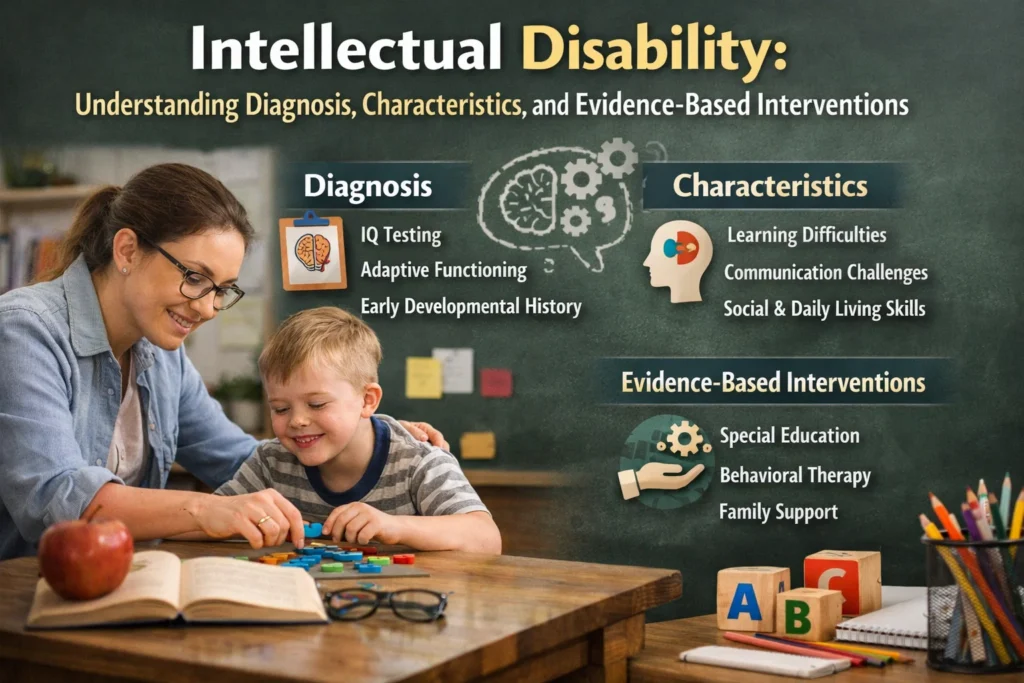
Intellectual Disability: Understanding Diagnosis, Characteristics, and Evidence-Based Interventions
What does it mean when someone has Intellectual Disability, and how can we support individuals with this condition to reach their full potential? Intellectual Disability (ID), also known as Intellectual Developmental Disorder, represents a neurodevelopmental condition characterized by significant limitations in both intellectual functioning and adaptive behavior that emerge during the developmental period. Far from defining a person’s worth or potential, this diagnosis describes specific support needs that, when appropriately addressed, allow individuals to live fulfilling, meaningful lives.
Therefore, understanding Intellectual Disability—its diagnostic criteria, causes, presentations, and evidence-based interventions—becomes essential for families, educators, healthcare providers, and communities. The condition affects approximately 1-3% of the global population, making it one of the most common developmental disabilities. Historically, this condition has been misunderstood, stigmatized, and poorly served by support systems. However, advances in diagnostic precision, intervention strategies, and societal attitudes have transformed possibilities for individuals with ID. In this article, we will explore the clinical foundations of Intellectual Disability as defined in the DSM-5, examine how it manifests across severity levels, investigate causes and risk factors, and present comprehensive, evidence-based approaches to intervention and support that maximize independence and quality of life.
Understanding Intellectual Disability: Clinical Definition
Before examining specific criteria and presentations, we must understand how Intellectual Disability is clinically conceptualized and how diagnostic approaches have evolved.
Historical Context and Terminology
The terminology surrounding this condition has evolved significantly, reflecting changing societal attitudes and clinical understanding. The term “mental retardation,” used for decades in clinical and legal contexts, was abandoned due to its pejorative connotations and the profound stigma attached to it. In 2010, Rosa’s Law officially replaced “mental retardation” with “intellectual disability” in federal legislation.
The DSM-5, published in 2013, adopted the term “Intellectual Disability (Intellectual Developmental Disorder)” to align with international classification systems and reduce stigma while maintaining diagnostic precision. This terminology emphasizes that the condition involves developmental processes rather than suggesting permanent limitation or lack of value.
Understanding this evolution matters because language shapes perception. The shift from “mental retardation” to “intellectual disability” represents more than semantic preference—it reflects a fundamental reconceptualization of the condition as one requiring support rather than one defining worth or potential.
Core Concept: Limitations in Intellectual and Adaptive Functioning
Intellectual Disability fundamentally involves limitations in two distinct but related domains: intellectual functioning and adaptive behavior. Intellectual functioning refers to general mental abilities including reasoning, planning, problem-solving, abstract thinking, judgment, academic learning, and learning from experience. This is typically assessed through standardized intelligence testing yielding an Intelligence Quotient (IQ) score.
Adaptive functioning refers to how effectively individuals meet developmental and sociocultural standards for personal independence and social responsibility in everyday life. This encompasses practical skills necessary for daily living across multiple environments including home, school, work, and community settings.
The diagnosis requires significant limitations in both domains. Someone might score low on intelligence testing but function adequately in daily life, or conversely, have adequate intellectual abilities but struggle with practical independence. Intellectual Disability requires documented deficits in both areas, distinguishing it from specific learning disabilities or other conditions affecting only certain domains.
Developmental Period Onset
A critical defining feature is that Intellectual Disability must have onset during the developmental period—generally understood as before age 18. This criterion distinguishes ID from conditions causing intellectual decline in adulthood such as traumatic brain injury, stroke, or neurodegenerative disorders like Alzheimer’s disease.
The developmental period specification reflects the fact that ID emerges during years when the brain is actively developing and acquiring foundational capacities. Conditions causing intellectual impairment after this period are classified differently, typically as neurocognitive disorders rather than intellectual disabilities.
This distinction carries important implications for intervention, legal considerations, and understanding prognosis. Intellectual Disability present from early development affects how the entire developmental trajectory unfolds, whereas adult-onset conditions involve loss of previously acquired abilities—fundamentally different experiences requiring different support approaches.
DSM-5 Diagnostic Criteria
The Diagnostic and Statistical Manual of Mental Disorders, Fifth Edition (DSM-5) provides specific criteria that must be met for Intellectual Disability diagnosis. Understanding these criteria ensures accurate identification and appropriate support.
Criterion A: Deficits in Intellectual Functioning
The first diagnostic criterion requires deficits in intellectual functions confirmed by both clinical assessment and standardized intelligence testing. Specific areas of intellectual functioning that may be impaired include reasoning and problem-solving abilities, planning and organizing complex tasks, abstract thinking and understanding conceptual relationships, judgment and decision-making in practical situations, academic learning across subjects, and learning from experience to modify future behavior.
Intellectual functioning is typically assessed through comprehensive intelligence tests administered by qualified psychologists. The DSM-5 notes that ID is generally indicated by performance approximately two standard deviations or more below the population mean—corresponding to an IQ score of about 70 or below.
However, the DSM-5 explicitly emphasizes that diagnosis should not rely solely on IQ scores. Test scores can be influenced by factors including test-taking anxiety, cultural and linguistic background, sensory or motor impairments, and practice effects from repeated testing. Clinical judgment considering the complete picture of functioning is essential.
Criterion B: Deficits in Adaptive Functioning
The second criterion requires deficits in adaptive functioning that result in failure to meet developmental and sociocultural standards for personal independence and social responsibility. Without ongoing support, these adaptive deficits limit functioning in one or more activities of daily life across multiple environments.
Adaptive functioning is assessed across three domains. The conceptual domain includes language, reading, writing, mathematics, reasoning, knowledge, and memory—essentially academic or cognitive aspects of adaptation. The social domain encompasses awareness of others’ thoughts and feelings, empathy, interpersonal communication, friendship abilities, and social judgment. The practical domain involves self-care, job responsibilities, money management, recreation, organizing tasks and activities, and safety awareness.
Adaptive functioning is measured through standardized assessment tools administered to caregivers or through direct observation. Significant limitations in adaptive functioning manifest as needing substantial support to achieve independence in daily activities appropriate for age and cultural context.
Criterion C: Onset During Developmental Period
The third criterion specifies that intellectual and adaptive deficits must have onset during the developmental period. As noted, this typically means before age 18, though the DSM-5 doesn’t specify an exact cutoff, recognizing that developmental periods may vary slightly across individuals and cultures.
Evidence of developmental period onset might include early childhood developmental delays, special education services during school years, documented cognitive or adaptive functioning assessments from childhood, or retrospective clinical history indicating limitations present since early development.
Severity Specification Based on Adaptive Functioning
Importantly, the DSM-5 specifies severity levels—mild, moderate, severe, or profound—based on adaptive functioning rather than IQ scores. This represents a significant shift from earlier diagnostic manuals that based severity primarily on intelligence test scores.
The rationale for this change reflects recognition that adaptive functioning better predicts support needs and real-world outcomes than IQ scores alone. Someone with relatively higher IQ but poor adaptive skills may need more support than someone with lower IQ but stronger practical abilities. Severity classification guides appropriate intervention planning and resource allocation.
Severity Levels: Understanding the Spectrum
Intellectual Disability exists on a spectrum of severity, with individuals experiencing vastly different levels of impairment and support needs. Understanding these levels helps tailor appropriate interventions and set realistic but hopeful expectations.
Mild Intellectual Disability
Mild ID represents approximately 85% of all ID cases, making it by far the most common severity level. Individuals with mild ID typically develop social and communication skills during preschool years, though with some delay compared to typically developing peers.
In the conceptual domain, individuals may struggle with abstract academic subjects but can achieve practical academic skills including basic reading, writing, and mathematics sufficient for daily functioning. They may need support for complex tasks like financial planning or healthcare navigation but can learn vocational skills and work independently or with modest supervision.
Socially, subtle differences in social judgment and communication may exist, with potential difficulty understanding complex social cues or managing peer relationships during adolescence. However, many individuals develop satisfying friendships and romantic relationships with appropriate support.
Practically, adults with mild ID can often achieve substantial independence including living independently or with minimal support, managing personal care and household tasks, using public transportation, and working in competitive or supported employment. The key distinction from typical functioning is the need for support during transitions, new situations, or complex decision-making.
Moderate Intellectual Disability
Moderate ID affects approximately 10% of individuals with intellectual disabilities. Language and communication skills develop during childhood but at significantly slower rates and often with less complexity than typical peers.
Conceptually, individuals with moderate ID typically achieve early elementary academic skills—basic reading, simple mathematics—but struggle with more complex academic subjects. They can learn job skills but require ongoing support and supervision in work settings.
Social understanding is generally more concrete, with difficulty interpreting subtle social situations or understanding complex social rules. However, with support, individuals can develop meaningful relationships and participate in community activities. They may need assistance navigating social situations and understanding others’ perspectives.
Practically, adults with moderate ID can generally manage personal care (eating, dressing, hygiene) with reminders and some assistance. They can participate in household tasks with support and supervision. Most require supported living arrangements, whether with family, in group homes, or with in-home support services. Employment typically occurs in sheltered or highly supported settings.
Severe Intellectual Disability
Severe ID affects approximately 3-4% of individuals with intellectual disabilities. Language development is minimal, with understanding and use of simple speech or alternative communication methods rather than complex language.
In the conceptual domain, individuals understand simple instructions and can learn basic matching, sorting, and recognition skills but generally do not acquire traditional academic abilities like reading or mathematics. Understanding remains focused on concrete, immediate experiences rather than abstract concepts.
Socially, communication focuses on concrete needs and immediate situations. Individuals can recognize familiar people and situations and often form strong attachments to caregivers, though social interaction remains limited compared to typical development.
Practically, individuals with severe ID require substantial support for all daily living activities including eating, dressing, bathing, and toileting. They may participate partially in these activities with guidance but cannot perform them independently. Constant supervision is necessary for safety. Living arrangements typically involve family homes with extensive support or residential facilities providing comprehensive care.
Profound Intellectual Disability
Profound ID affects approximately 1-2% of individuals with intellectual disabilities and represents the most significant level of impairment. Conceptual skills focus on physical rather than symbolic processes, with very limited understanding of language or concepts.
Communication may be entirely nonverbal, using gestures, sounds, or expressions to indicate basic needs and preferences. Understanding focuses on immediate physical and social situations rather than abstract or symbolic information.
Socially, individuals may respond to direct physical and social approaches and show pleasure or distress in response to familiar people and situations. However, interaction abilities are severely limited, and communication remains largely through nonverbal means.
Practically, individuals with profound ID require complete assistance for all activities of daily living including eating (may require specialized feeding), mobility (many have significant motor impairments), bathing, dressing, and toileting. They need 24-hour supervision and care, typically in residential settings with specialized medical and support staff. Many have co-occurring medical conditions requiring ongoing healthcare.
Causes and Risk Factors
Intellectual Disability arises from diverse causes affecting brain development and functioning. Understanding etiology helps with prevention, genetic counseling, and sometimes guides specific interventions.
Genetic Causes
Genetic factors account for a substantial proportion of ID cases, particularly at more severe levels. These include chromosomal abnormalities where entire chromosomes or large chromosomal sections are affected, single gene disorders caused by mutations in specific genes, and inherited metabolic disorders affecting how the body processes nutrients.
Down syndrome represents the most common chromosomal cause of ID, occurring when individuals have three copies of chromosome 21 instead of the typical two. This affects approximately 1 in 700 births and causes characteristic physical features alongside intellectual disability typically in the mild to moderate range.
Fragile X syndrome is the most common inherited cause of ID, particularly affecting males, and results from a mutation in the FMR1 gene on the X chromosome. It causes ID ranging from mild to severe alongside characteristic behavioral features including social anxiety and attention difficulties.
Phenylketonuria (PKU) exemplifies inherited metabolic disorders. Without treatment, this condition causes severe ID, but when detected through newborn screening and treated with dietary restrictions, individuals develop typically. This demonstrates the critical importance of early detection and intervention for some genetic causes.
Prenatal Factors
Conditions affecting fetal development during pregnancy can cause ID. Maternal infections during pregnancy including rubella, toxoplasmosis, cytomegalovirus, and Zika virus can damage the developing fetal brain. The risk and severity depend on timing of infection, with earlier infections typically causing more severe effects.
Maternal substance use during pregnancy including alcohol (causing Fetal Alcohol Spectrum Disorders), illicit drugs, and certain medications can impair fetal brain development. Fetal Alcohol Syndrome represents a leading preventable cause of ID in many countries.
Maternal malnutrition, particularly deficiencies in iodine, folic acid, or other essential nutrients, can impair fetal brain development. Severe maternal illness or complications including uncontrolled diabetes or hypertension can also affect fetal development.
Exposure to environmental toxins such as lead, mercury, or radiation during pregnancy poses risks to fetal brain development, with effects varying based on timing, duration, and severity of exposure.
Perinatal Factors
Complications during labor and delivery can cause ID. Severe hypoxia (oxygen deprivation) during birth can damage brain tissue, particularly if prolonged. This might occur due to umbilical cord problems, placental abruption, or other delivery complications.
Extreme prematurity, particularly birth before 28 weeks gestation, carries increased risk of ID due to brain immaturity and complications of premature birth including intraventricular hemorrhage (bleeding in the brain) and periventricular leukomalacia (damage to white matter).
Very low birth weight, even in term infants, correlates with increased risk of developmental difficulties. Severe neonatal infections such as meningitis or sepsis can cause brain damage leading to ID.
Postnatal Factors
After birth, various factors can cause ID if they occur during the developmental period. Traumatic brain injury from accidents, falls, or abuse can cause permanent intellectual impairment if sufficiently severe.
Infections affecting the brain including meningitis (infection of the membranes surrounding the brain) or encephalitis (brain inflammation) can cause permanent damage. Severe malnutrition during early childhood, particularly protein-energy malnutrition, can impair brain development.
Exposure to neurotoxins such as lead (from paint, contaminated water, or soil), mercury, or other toxic substances during childhood can cause brain damage. Severe psychosocial deprivation, such as that documented in children raised in severely neglectful institutions, can impair cognitive development, though some recovery is possible with later enriched environments.
Idiopathic Cases
Despite advances in diagnostic technology, approximately 30-40% of ID cases remain idiopathic—meaning no specific cause can be identified despite thorough evaluation. This percentage is higher for mild ID and lower for severe/profound ID where identifiable genetic or structural brain abnormalities are more common.
Idiopathic cases may result from complex interactions between multiple genetic variants and environmental factors, subtle genetic changes not detected by current testing, or other factors not yet understood. The inability to identify specific cause doesn’t change intervention approaches, which remain focused on addressing the individual’s specific needs and strengths.
Evidence-Based Interventions and Support
While Intellectual Disability is a lifelong condition, appropriate interventions significantly improve functioning, independence, and quality of life. Evidence-based approaches address multiple domains of development and daily living.
Early Intervention Programs
Research consistently demonstrates that early intervention—specialized services provided during infancy and early childhood—produces the best outcomes for children with ID. Federal law in many countries mandates early intervention services for eligible children from birth to age three.
Early intervention typically includes developmental therapies addressing cognitive, motor, and communication skills, parent training and support to help families promote development, specialized instruction adapted to the child’s learning needs, and coordination of medical and therapeutic services.
These programs use developmentally appropriate activities embedded in natural routines rather than isolated therapy sessions. For example, communication goals might be addressed during mealtimes, play, and daily caregiving rather than only during formal speech therapy. Family involvement is central, as parents and caregivers are the child’s primary teachers and advocates.
Research shows that high-quality early intervention improves cognitive development, adaptive behavior, academic readiness, and family functioning. While it doesn’t “cure” ID, it maximizes the child’s developmental potential and establishes foundations for lifelong learning.
Educational Approaches and Inclusive Education
School-age children with ID benefit from specialized educational approaches within the least restrictive environment appropriate for their needs. The principle of least restrictive environment means educating children with disabilities alongside typically developing peers to the maximum extent appropriate.
For many children with mild or moderate ID, this involves inclusion in general education classrooms with appropriate supports including modified curriculum addressing the same content at appropriate complexity levels, specialized instruction in areas of difficulty, assistive technology supporting learning and communication, and paraprofessional support when needed.
For students with more severe ID, specialized self-contained classrooms may be appropriate, focusing on functional academic skills, life skills training, vocational preparation, and community-based instruction. However, even students in specialized settings benefit from opportunities for integration with typical peers during non-academic activities.
Evidence-based instructional strategies for students with ID include systematic instruction with task analysis (breaking complex skills into smaller steps), explicit instruction with clear modeling and guided practice, repeated practice with varied examples to promote generalization, positive reinforcement strategies to motivate learning, and errorless learning techniques that prevent incorrect responses.
Applied Behavior Analysis (ABA)
Applied Behavior Analysis represents a scientifically validated approach for teaching skills and reducing problem behaviors in individuals with ID. ABA applies principles of learning and motivation derived from behavioral psychology to promote meaningful behavior change.
Core ABA strategies include discrete trial training for teaching specific skills through structured repetition, natural environment training embedding teaching in everyday activities, positive reinforcement systematically rewarding desired behaviors, functional communication training teaching appropriate ways to meet needs, and behavior intervention plans addressing challenging behaviors.
Contrary to misconceptions, modern ABA is not rigid or robotic. Contemporary approaches emphasize naturalistic teaching, following the child’s interests, play-based learning, and family involvement. The goal is meaningful skill development that enhances quality of life, not mere compliance.
Research demonstrates ABA’s effectiveness for teaching academic skills, daily living skills, social interaction, communication, and reducing challenging behaviors across the ID spectrum. While originally developed for autism, ABA principles apply effectively to ID.
Speech and Language Therapy
Communication difficulties are common across all ID severity levels. Speech-language pathologists work to maximize communication abilities through developing spoken language when possible, teaching augmentative and alternative communication (AAC) for individuals who cannot speak, improving speech intelligibility, expanding vocabulary and language comprehension, and developing pragmatic language skills (social use of language).
For individuals who cannot develop functional speech, AAC systems including picture exchange systems, communication boards, or speech-generating devices provide alternative means of expression. Modern technology offers increasingly sophisticated and portable AAC options including tablet-based applications.
Early and intensive speech-language intervention significantly improves communication outcomes. Even individuals with severe ID can learn functional communication reducing frustration and problem behaviors that often stem from communication barriers.
Occupational Therapy
Occupational therapists address fine motor skills, sensory processing, and daily living skills. For young children, this includes developing hand-eye coordination, grasping and manipulation skills, and self-feeding abilities. For older children and adults, focus shifts to dressing skills, grooming and hygiene, meal preparation, household tasks, and prevocational skills like using tools.
Sensory integration therapy addresses sensory processing difficulties common in ID. Many individuals are hyper-sensitive or hypo-sensitive to sensory input (sounds, touch, movement), and occupational therapy helps them process sensory information more effectively.
Adaptive equipment and environmental modifications recommended by occupational therapists improve independence. This might include specialized utensils for eating, adapted clothing for easier dressing, or bathroom modifications for safety.
Social Skills Training
Individuals with ID often struggle with social interaction and peer relationships. Structured social skills training teaches specific skills including initiating and maintaining conversations, understanding social rules and norms, recognizing and responding to social cues, perspective-taking and empathy, friendship skills, and conflict resolution.
Effective social skills training uses modeling (demonstrating desired behavior), role-playing (practicing in safe settings), feedback (corrective and reinforcing comments), and real-world practice with support. Video modeling, where individuals watch videos of target behaviors, has shown particular promise.
Peer-mediated interventions involve training typically developing peers to interact with and support individuals with ID. This approach promotes natural social interaction, benefits both parties, and creates more inclusive environments.
Vocational Training and Supported Employment
Adolescents and adults with ID benefit from vocational preparation and employment support. Transition planning during high school identifies career interests and needed skills, leading to vocational training teaching job-specific and general workplace skills.
Supported employment places individuals in competitive jobs with ongoing support from job coaches. This model emphasizes real work in integrated settings rather than segregated sheltered workshops. Job coaches provide initial intensive training then fade support as individuals master job tasks.
Research shows that individuals with ID, including those with moderate severity, can successfully maintain competitive employment with appropriate support. Employment provides income, social connection, skill development, and enhanced self-esteem—critical contributors to quality of life.
Family Support and Caregiver Training
Families raising children or caring for adults with ID need ongoing support. Parent training programs teach behavior management strategies, techniques for teaching daily living skills, effective communication approaches, and advocacy skills for accessing services.
Respite care provides temporary relief for family caregivers, preventing burnout and allowing families to maintain their caregiving role long-term. Support groups connect families facing similar challenges, providing emotional support and practical information sharing.
Siblings of individuals with ID also need support. Sibling support programs address their unique experiences, questions, and needs while celebrating the positive aspects of growing up with a sibling with disabilities.
Life Across the Lifespan
Intellectual Disability affects individuals across their entire lifespan, with different challenges and opportunities emerging at different life stages.
Early Childhood
During infancy and early childhood, the focus is on developmental stimulation, establishing routines, family adjustment, and accessing early intervention services. Families often experience initial grief following diagnosis but gradually develop competence and confidence in supporting their child.
Early identification allows immediate intervention when brain plasticity is greatest. Many children with ID who receive high-quality early intervention enter school with stronger skills and better prognosis than would have occurred without intervention.
School Years
The school years bring academic challenges but also opportunities for learning and social development. Appropriate educational placement, effective instruction, peer relationships, and development of self-advocacy skills are central during this period.
Adolescence adds challenges of identity development, sexuality education, and transition planning. Adolescents with ID need age-appropriate information about bodies, relationships, and sexuality delivered in accessible ways. Transition planning beginning around age 14 prepares for adult life including further education, employment, and living arrangements.
Adulthood
Adult life for individuals with ID varies tremendously based on severity level and available supports. Many adults with mild ID live independently, maintain competitive employment, have romantic relationships, and participate fully in community life with minimal ongoing support.
Adults with moderate ID often live in supported group homes or with family and work in supported employment settings. They participate in community recreation and maintain friendships with appropriate support.
Adults with severe or profound ID typically require residential care or extensive in-home support. However, even with significant limitations, they can experience quality of life through appropriate care, meaningful activities, and respectful treatment.
Aging
Individuals with ID are living longer than previous generations due to improved medical care and living conditions. This creates new challenges including higher rates of early-onset health conditions, need for age-appropriate activities and services, and planning for transitions when aging parents can no longer provide care.
Some genetic causes of ID (particularly Down syndrome) carry increased risk of early-onset Alzheimer’s disease, requiring specialized dementia care. The field of aging and developmental disabilities is rapidly evolving to address these emerging needs.
Final Considerations
Intellectual Disability represents a diverse group of conditions unified by significant limitations in intellectual and adaptive functioning with onset during development. While challenges are real and lifelong, appropriate support enables individuals with ID to live meaningful, satisfying lives as valued members of their communities.
The shift from medical model focusing solely on deficits to a social model emphasizing support needs represents profound progress. Intellectual Disability doesn’t define a person’s worth, potential for growth, or capacity for happiness. With the right supports, individuals with ID learn, develop relationships, contribute to communities, and experience life satisfaction.
Early intervention, quality education, evidence-based therapies, employment opportunities, and inclusive community participation dramatically improve outcomes. Research consistently demonstrates that expectations shape reality—when we expect little and provide minimal support, individuals achieve little; when we maintain hopeful expectations and provide robust support, individuals often exceed our predictions.
Families play irreplaceable roles in supporting individuals with ID while also needing support themselves. The journey involves challenges, but most families report that loving someone with ID enriches their lives, teaching patience, acceptance, and appreciation for achievements regardless of scale.
Society benefits when individuals with ID are included, valued, and supported to contribute according to their abilities. Inclusive communities are stronger, more compassionate, and more vibrant. Legal protections, educational mandates, and disability rights movements have created unprecedented opportunities, though work remains to fully realize the promise of inclusion.
For families recently receiving an ID diagnosis, know that while the path may look different than imagined, it can still be beautiful. Connect with other families, access available services early, maintain hopeful realism, celebrate all achievements, and advocate tirelessly for your loved one. The diagnosis provides access to supports—it doesn’t limit potential.
For professionals working with individuals with ID, commit to evidence-based practices, person-centered planning, presumption of competence, and collaboration with families. Your work changes lives, creating possibilities that wouldn’t exist without your dedication and expertise.
Finally, for everyone, recognize that intellectual disability represents one form of human diversity. People with ID enrich our communities, teach us important lessons, and deserve the same rights, respect, and opportunities as everyone else. Building a truly inclusive society that values all people benefits everyone.
Read Also
- Autism Spectrum Disorder: Understanding the Diagnosis
- Early Childhood Development: Critical Milestones
- Applied Behavior Analysis: Evidence-Based Approach
- Special Education Services: A Parent’s Guide
- Supporting Siblings of Children with Disabilities
