
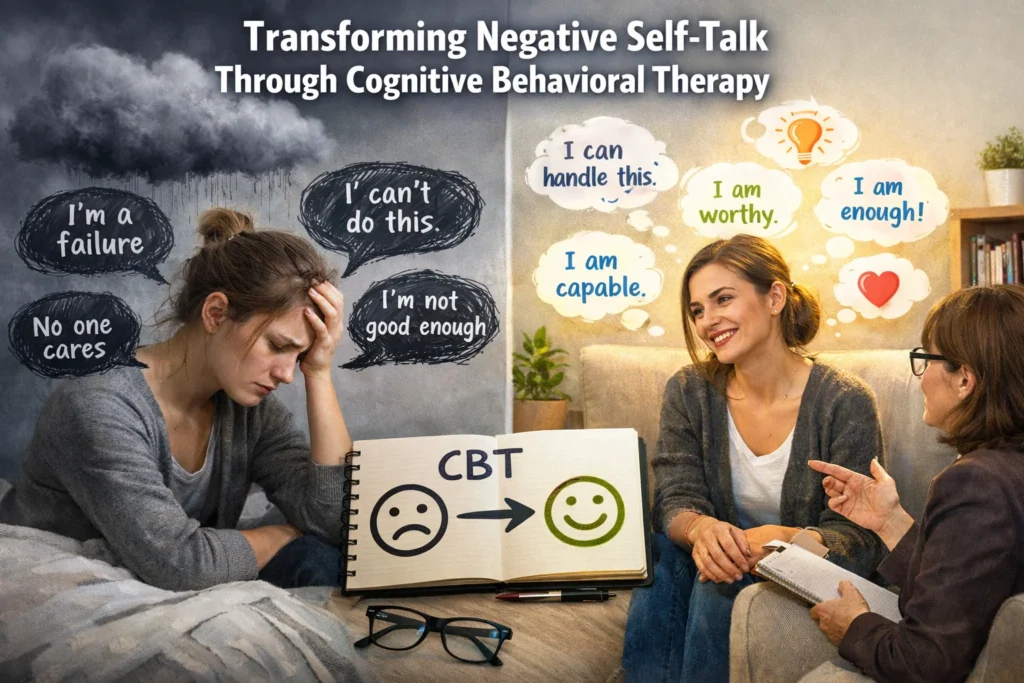
Transforming Negative Self-Talk Through Cognitive Behavioral Therapy
Internal conversation, or self-talk, is the ongoing dialogue we have with ourselves throughout each day. This inner voice plays a crucial role in shaping our thoughts, emotions, and behaviors. When this dialogue takes on a negative tone, it can significantly impact mental health and overall well-being. In Cognitive Behavioral Therapy (CBT), negative self-talk is considered a central factor in maintaining dysfunctional thought patterns and emotional disorders.
Understanding Negative Self-Talk
Negative self-talk refers to the critical, self-deprecating, or pessimistic internal monologue that often occurs automatically. These thoughts arise without conscious awareness and can manifest in several distinct patterns:
Overgeneralizations take isolated incidents and apply them universally: “I always make mistakes in everything I do.” A single error becomes evidence of complete incompetence across all areas of life.
Negative filtering involves focusing exclusively on the negative aspects of a situation while ignoring or dismissing positive elements. Someone might receive nine compliments and one criticism, yet fixate entirely on the critical comment.
Derogatory self-labeling reduces complex human beings to harsh, defining judgments: “I’m a failure” or “I’m worthless.” These labels become internalized identities rather than descriptions of specific behaviors or outcomes.
Catastrophic predictions assume the worst possible outcome: “This will go wrong, as always” or “I’ll never succeed at anything.” These thoughts create a sense of inevitable failure before events even unfold.
These patterns develop throughout life, influenced by negative experiences, external criticism from significant figures, and the formation of dysfunctional core beliefs about ourselves and the world. When these thoughts remain unexamined and unchanged, they contribute to anxiety, depression, low self-esteem, and a diminished quality of life.
CBT’s Approach to Changing Self-Talk
Cognitive Behavioral Therapy operates on the principle that our thoughts directly influence our emotions and behaviors. By transforming negative self-talk, we can improve emotional well-being and quality of life. CBT employs several evidence-based strategies to achieve this transformation.
Identifying Automatic Negative Thoughts
The first step involves learning to recognize negative thoughts as they arise. Many people experience these thoughts so habitually that they barely register their presence. Thought recording—writing down negative thoughts when they occur—helps bring them into conscious awareness.
During moments of emotional discomfort, pause and ask yourself: “What was I thinking just before I started feeling this way?” This simple question can reveal the hidden thoughts driving your emotional state. Over time, you’ll recognize patterns in when and how these thoughts emerge.
Challenging Dysfunctional Thoughts
Once identified, negative thoughts must be examined critically rather than accepted as truth. This process involves asking questions that test the validity and usefulness of these thoughts:
Is there real evidence to support this thought, or am I jumping to conclusions? What facts contradict this thought? Am I focusing on one aspect while ignoring others? What would I say to a friend who expressed this thought about themselves? Is this thought helping me or hurting me?
These questions create distance between you and your thoughts, allowing you to evaluate them objectively rather than being controlled by them.
Replacing with Balanced Thoughts
After challenging negative thoughts, the next step involves developing more realistic and constructive alternatives. This doesn’t mean replacing negativity with unrealistic positivity, but rather with balanced, evidence-based thinking.
Replace “I never do anything right” with “I don’t always get things right, but I’m learning and working to improve.” This acknowledges struggles without defining yourself by them. Replace “Everyone thinks I’m incompetent” with “Some people have criticized my work, but others have praised it, and I’m developing my skills.”
Cultivating Self-Compassion
Treating yourself with kindness and understanding represents a powerful antidote to self-criticism. Self-compassion involves recognizing that everyone makes mistakes, has limitations, and experiences difficulties. You wouldn’t berate a friend for a mistake—why apply harsher standards to yourself?
When you notice self-criticism arising, consciously shift to a more compassionate inner voice. Acknowledge your pain without judgment: “This is really difficult right now, and it’s okay that I’m struggling.” This approach fosters resilience rather than shame.
Practicing Mindfulness
Mindfulness teaches you to observe your thoughts without automatically believing or reacting to them. Through mindfulness, you learn to notice negative thoughts as mental events rather than absolute truths about yourself or reality.
When a negative thought arises, you can acknowledge it: “I’m having the thought that I’m not good enough,” rather than “I’m not good enough.” This subtle shift creates psychological distance and reduces the thought’s power to trigger distress. Regular mindfulness practice promotes mental clarity and reduces automatic identification with negative self-talk.
Developing Coping Skills
Beyond working directly with thoughts, CBT helps develop practical coping strategies for challenging situations. These include relaxation techniques that reduce physiological stress, problem-solving skills that address difficulties directly, and emotional regulation strategies that help manage intense feelings without being overwhelmed by them.
The Psychologist’s Role
Psychologists serve as essential guides in transforming negative self-talk, offering expertise, support, and accountability throughout the change process.
A skilled psychologist helps identify recurring negative thought patterns and their triggers, making visible what has been automatic and unconscious. They explore the origins of dysfunctional core beliefs—often rooted in early experiences—and facilitate their reinterpretation from an adult perspective.
Psychologists teach cognitive restructuring techniques, providing concrete strategies to replace irrational thoughts with more balanced ones. They introduce practices that promote self-compassion and help clients develop kinder relationships with themselves.
Throughout treatment, psychologists monitor progress, celebrate improvements, and adjust interventions as needed. This ongoing support provides motivation and ensures strategies remain effective as challenges evolve.
The Benefits of Transforming Self-Talk
Changing negative self-talk creates cascading positive effects across multiple areas of life:
Anxiety and depression levels decrease as catastrophic thinking patterns diminish and more balanced perspectives emerge. Self-esteem and self-confidence increase when harsh self-criticism gives way to realistic self-assessment and self-compassion.
Performance in challenging situations improves when you’re not battling an internal critic alongside external obstacles. Relationships become healthier and more fulfilling as the way you treat yourself influences how you engage with others.
Overall life satisfaction increases as you develop a more supportive internal environment. The energy previously consumed by negative self-talk becomes available for growth, creativity, and meaningful pursuits.
Recognizing When to Seek Help
While everyone experiences occasional negative thoughts, persistent negative self-talk that causes significant distress or impairs functioning requires professional attention. Consider seeking help from a qualified psychologist if:
Your internal dialogue consistently includes harsh self-criticism or catastrophic predictions. Negative thoughts significantly impact your work performance, relationships, or physical health. You feel trapped by your thoughts and unable to shift perspectives on your own. You experience symptoms of anxiety or depression alongside negative self-talk.
A psychologist can guide you through the transformation process, helping you develop self-awareness and practical tools for managing your internal dialogue effectively.
Moving Toward a Healthier Internal Dialogue
Negative self-talk represents a powerful but changeable habit. It doesn’t have to define your experience or limit your potential. Cognitive Behavioral Therapy offers proven methods for transforming self-destructive thoughts into supporters of personal growth and well-being.
With dedication, professional guidance when needed, and consistent application of CBT strategies, you can build a more positive and balanced relationship with yourself. This transformation leads to greater emotional stability, improved resilience, and a more fulfilling life. The voice in your head can shift from critic to coach, from obstacle to ally, creating an internal environment where you can truly thrive.
