
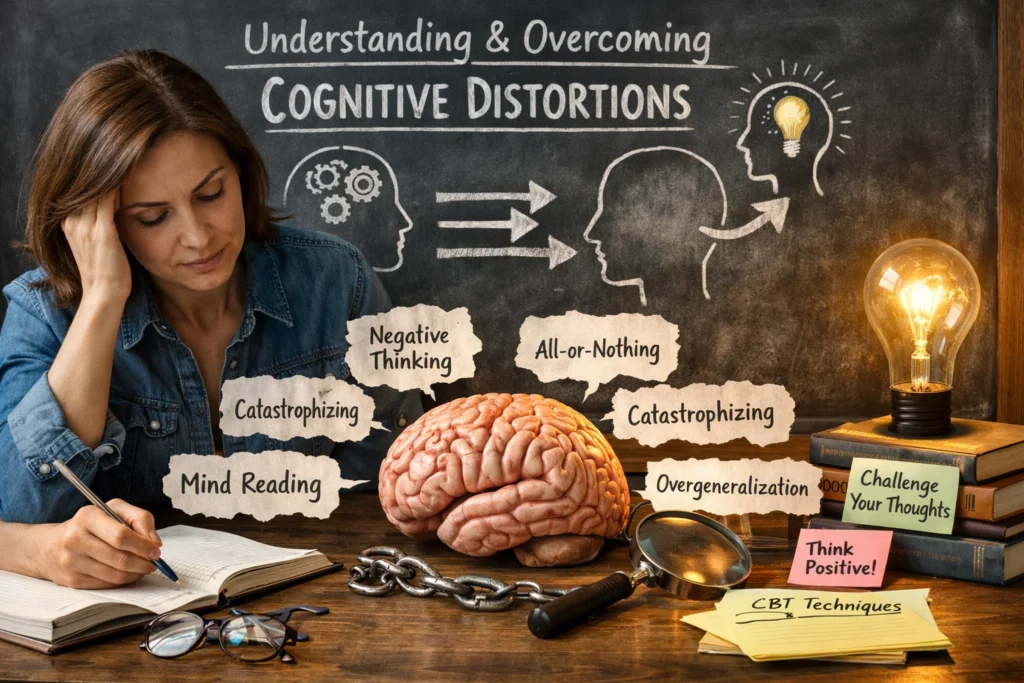
Understanding and Overcoming Cognitive Distortions
Cognitive distortions, a central concept in cognitive behavioral therapy (CBT), are inaccurate or biased thought patterns that negatively influence how we perceive ourselves, others, and the world around us. These distortions contribute to dysfunctional emotions and behaviors, hindering effective problem-solving and undermining well-being. Understanding these patterns represents the essential first step toward addressing them effectively.
What Are Cognitive Distortions?
Cognitive distortions are systematic errors in how we process information. Everyone makes these thinking errors occasionally—they’re a natural part of human cognition. However, when these thought patterns become habitual, they can significantly damage mental health.
Consider someone who interprets constructive feedback as a personal attack, triggering feelings of inadequacy or anger. Or imagine a person who makes one mistake at work and immediately concludes they’re incompetent at their job. These distortions operate automatically, below conscious awareness, which makes their impact particularly insidious. We react to distorted thoughts as if they represent objective reality rather than biased interpretations.
Common Types of Cognitive Distortions
Understanding specific types of cognitive distortions helps us recognize them in our own thinking. Here are some of the most prevalent patterns:
All-or-Nothing Thinking
Also called black-and-white thinking, this distortion involves viewing situations in extremes without acknowledging middle ground or nuance. Life becomes a series of absolutes—success or failure, perfect or worthless, completely good or entirely bad.
Someone engaged in all-or-nothing thinking might conclude: “If I don’t perform perfectly in this presentation, I’m a total failure.” A single argument with a partner becomes: “My relationship is a complete disaster.” This cognitive pattern ignores the reality that most experiences fall somewhere in the middle of these extremes.
Catastrophizing
Catastrophizing involves anticipating the worst possible outcome regardless of its actual probability. This distortion magnifies potential negative consequences far beyond reasonable likelihood.
A person might think: “If I mess up this task, I’ll certainly be fired and never find another job.” A minor headache becomes: “This is probably a sign of a serious medical condition.” This pattern creates constant anxiety about hypothetical disasters that rarely materialize.
Personalization
Personalization involves assuming responsibility for external events beyond your control. People experiencing this distortion interpret neutral or negative events as directly caused by their actions or personal failings.
Examples include: “My friends seemed distant today; I must have done something wrong,” or “My son performed poorly in school because I’m a negligent parent.” This thinking pattern ignores the multitude of factors that influence other people’s behavior and outcomes, placing undue blame on oneself.
Mind Reading
Mind reading occurs when someone assumes they know what others are thinking without concrete evidence. This distortion involves making confident judgments about others’ thoughts, feelings, or intentions based on speculation rather than communication.
Someone might think: “He didn’t reply to my message because he must think I’m annoying,” or “They’re laughing because they’re mocking me.” In reality, countless explanations exist for others’ behavior, most having nothing to do with you.
Overgeneralization
Overgeneralization takes a single negative event as evidence that an endless pattern of failure will continue. One disappointing experience becomes proof that you’ll always fail in similar situations.
This manifests in thoughts like: “I did badly on that test; I’ll never be good at math,” or “That interview was a disaster; I’ll never get a job.” A single data point becomes an ironclad prediction about the future, ignoring evidence of past successes and the possibility of improvement.
Other Common Distortions
While these five represent some of the most frequent patterns, other distortions include emotional reasoning (believing something is true because it feels true), should statements (imposing rigid rules about how things “should” be), labeling (defining yourself or others by a single characteristic), and discounting the positive (dismissing achievements or positive experiences as meaningless).
Why Cognitive Distortions Are Problematic
Distorted thought patterns don’t simply create uncomfortable emotions—they have far-reaching consequences for mental health and quality of life.
These thinking errors perpetuate and intensify negative emotions. Anxiety feeds on catastrophizing, while depression thrives on all-or-nothing thinking and overgeneralization. The distorted thoughts create emotional reactions, which then seem to validate the distorted thoughts, creating a self-reinforcing cycle.
Cognitive distortions impair judgment and decision-making abilities. When you catastrophize, you may avoid reasonable risks. When you engage in all-or-nothing thinking, you may abandon goals at the first setback. When you personalize, you may withdraw from relationships unnecessarily.
These patterns reinforce negative core beliefs about yourself, others, and the world. Repeated thoughts like “I’m not good enough” or “The world is dangerous” become internalized beliefs that shape your identity and worldview. Over time, this contributes to the development and maintenance of emotional disorders including anxiety, depression, and low self-esteem.
Addressing Cognitive Distortions Through CBT
CBT offers practical, evidence-based tools for identifying and correcting thinking errors. The process involves several key strategies that work together to create lasting change.
Recognizing the Patterns
The first step involves learning to identify distorted thought patterns as they occur. Most people have engaged in these patterns for years without conscious awareness, so developing this skill requires patience and practice.
Keeping a thought journal proves invaluable during this phase. When you notice yourself feeling distressed, pause and write down: the situation that triggered the emotion, the automatic thoughts that arose, the emotions you felt, and the intensity of those emotions. Over time, you’ll recognize recurring patterns and identify which distortions appear most frequently in your thinking.
Questioning Distorted Beliefs
Once you’ve identified a cognitive distortion, the next step involves actively challenging it. Rather than accepting your automatic thoughts as truth, examine them critically with questions like:
What concrete evidence supports this thought? What evidence contradicts it? Am I confusing a feeling with a fact? Is there another reasonable explanation for this situation? Am I considering all relevant information or focusing selectively on negatives? What would I tell a friend who expressed this thought? Am I predicting the future or dealing with what’s actually happening? What’s the worst that could realistically happen, and could I handle it?
These questions create distance between you and your thoughts, allowing you to evaluate them objectively rather than being controlled by them.
Restructuring Thoughts
After challenging distorted thinking, replace it with more balanced and realistic alternatives. This doesn’t mean forcing artificial positivity—it means developing thoughts that accurately reflect reality.
Original thought: “If I make a mistake, everyone will judge me harshly.” Restructured thought: “Everyone makes mistakes; they’re part of learning. Most people will probably understand, and even if someone judges me, I can handle it.”
Original thought: “This presentation will be a disaster.” Restructured thought: “This presentation might not be perfect, but I’m prepared and will do my best. Even if some parts don’t go smoothly, I can recover and learn from the experience.”
The restructured thoughts acknowledge challenges without catastrophizing them, creating a more balanced and helpful perspective.
Maintaining Practice and Persistence
Changing long-standing thought patterns requires consistent effort over time. These distortions developed through years of repetition, and replacing them with healthier patterns demands patience and persistence.
Practice cognitive restructuring daily, even with minor distortions. Celebrate small victories when you catch and correct a distorted thought. Over time, more balanced thinking becomes increasingly automatic, requiring less conscious effort.
Working with a trained CBT therapist accelerates this process by providing expert guidance, accountability, and support through challenges. A therapist can help you identify patterns you might miss and develop personalized strategies for your specific distortions.
Building a More Balanced Perspective
Cognitive distortions are common thought patterns that significantly influence emotions and behavior, but they don’t have to dominate your mental landscape. With awareness, practice, and the right tools, you can recognize, question, and overcome these distortions.
Developing more realistic and balanced thinking promotes greater emotional well-being, improves decision-making, and helps build healthier relationships. The process takes time and effort, but the rewards—reduced anxiety and depression, increased resilience, and a more accurate view of yourself and the world—make the investment worthwhile.
By learning to think more clearly and accurately, you create space for genuine well-being and authentic engagement with life as it actually is, rather than as your distorted thoughts portray it.
